• Instagram Facebook Twitter YouTube e-Mail RSS

Denouncing the silent war
Spain is waging against Catalonia


2018/11/18

The Catalan Company 1302 AD – 1388 AD

Charles of Anjou with a French army invaded Italy and conquered the Kingdom of Sicily in 1266, losing the island of Sicily in the War of the Sicilian Vespers from 1282, but retaining the Kingdom of Naples for his heirs. 

In 1282 the Sicilians revolted against Charles, massacred his French supporters and invited Pere III of Aragon to rule them. Bringing a force of Aragonese and Catalans, he fought the War of the Sicilian Vespers. Peace in 1301 left Sicily in Aragonese hands, Naples in Angevin hands and a dangerous surplus of Catalans, soon transferred to Byzantine service as the notorious Catalan Grand Company.

The Catalan Grand Company from its departure from Sicily until the fall of the state it founded in Greece to the Florentines. During this time it fought for both Byzantines and Romanian Franks, was short-changed by both, took a horrid revenge on both, and beat every Turkish, Byzantine and Frankish army that got in its way. Its Alan allies were allied only because hired by the Byzantines to assist the Grand Company. The relations between the two ranged from veiled hostility to naked hostility. After the Byzantine assassination of its great leader Roger de Flor, the company was largely commanded by committee, often through a figurehead. It is said to have been highly disciplined, although displaying extremely rapacious behaviour towards even friendly civilians. Despite having left Aragonese service under a cloud after backing the wrong heir, the Company continued to fight under the banner of Aragon [yellow with horizontal red stripes].

The Catalan companies in the East. – Andronicus could not master the situation without foreign aid, and he got such aid from the Catalan mercenary bands, the so-called “Catalan companies,” or “almughavars.” Mercenary bands of various nationalities, under the name of “companies,” which lived only for war and would fight for pay for anyone against anyone, were very well known in the latter half of the Middle Ages. “The Catalan companies,” which consisted not only of Catalans, but also of the inhabitants of Aragon, Navarre, the island of Majorca, and other places, fought as mercenaries on the side of Peter of Aragon during the war which burst out after the Sicilian Vespers. When at the very beginning of the fourteenth century a peace was concluded between Sicily and Naples, the Catalans were out of work. Such allies, accustomed to war, pillage, and violence, became in time of peace dangerous to those who had invited them, and who now tried to get rid of them. Moreover, the companies themselves, finding no satisfaction in peaceful living conditions, sought new opportunities for activity. The Catalans chose for leader Roger de Flor, a German by origin, whose father’s surname, Blum (i.e. a flower), was translated into Catalan as “Flor.” 

With the consent of his companions Roger, who spoke Greek fluently, offered his services to Andronicus II for his struggle with the Seljuq and Ottoman Turks and extorted from the hard pressed Emperor unheard-of conditions: the insolent adventurer demanded the consent of Andronicus to his marriage with the Emperor’s niece, the granting of the title of megadukas (admiral), and a large sum of money for his company. Andronicus was compelled to yield, and the Catalan companies took ship and sailed for Constantinople.

The participation of the Catalans in the destinies of Byzantium is narrated in detail both in the Catalan sources and in the Greek. But while a participant of the expedition, the Catalan chronicler Muntaner described Roger and his companions as courageous and noble fighters for a right cause, a credit to their country, Greek historians consider the Catalans pillagers and insolent ruffians, and one of them exclaimed: “Would that Constantinople had never seen the Latin Roger!” Historians of the nineteenth century devoted much attention to the Catalan expedition. A Spanish investigator of the problem compared their deeds with those of the famous Spanish conquerors of Mexico and Peru in the sixteenth century, Cortez and Pizarro; he does not know “what other people may plume themselves on such a historical event as our glorious expedition to the East,” and he considered the expedition an eternal testimony to the glory of the Spanish race. 

The German historian Hopf declared that “the Catalan expedition is the most attractive episode in the history of the Empire of the Palaeologi,” especially on account of its dramatic interest. Finlay wrote that the Catalans “guided by a sovereign like Leo III or like Basil II, might have conquered the Seljuq Turks, strangled the Ottoman power in its cradle, and carried the double-headed eagle of Byzantium victorious to the foot of Mount Taurus and to the banks of the Danube.” 
Elsewhere the same historian remarked: “The expedition of the Catalans in the East is a wonderful instance of the success which sometimes attends a career of rapacity and crime, in opposition to all the ordinary maxims of human prudence.” The Spanish archives still afford much new information on this expedition.

At the very beginning of the fourteenth century Roger de Flor with his company arrived in Constantinople. There were almost ten thousand members of the expedition; but this number included wives, mistresses, and children. The marriage of Roger to the Emperor’s niece was celebrated at Constantinople with great pomp. After some serious conflicts in the capital between the Catalans and Genoese, who, jealous for their exceptional privileges in the Empire, felt the newcomers their rivals, the company was finally transported into Asia Minor, where the Turks were besieging the large city of Philadelphia, east of Smyrna. Supported by a band of imperial troops the small Hispano-Byzantine army, under Roger de Flor, freed Philadelphia from the Turkish siege. The victory of the western mercenaries was enthusiastically received in the capital; some men thought that the Turkish danger to the Empire was over forever. 

The first success was followed by others against the Turks in Asia Minor. But the unbearable extortions and arbitrary cruelties of the Catalans towards the local population, on one hand, and the clearly expressed intention of Roger to establish in Asia Minor a principality of his own, though under the Emperor’s suzerainty, on the other, strained the relations between the mercenaries, the people of Asia Minor, and the government of Constantinople. The Emperor recalled Roger to Europe, and the latter with his company crossed the Hellespont and occupied first an important fortress on the straits of Gallipoli, and then the whole peninsula of Gallipoli. The new negotiations between Roger and the Emperor ended in Roger’s obtaining the title next to the Emperor’s, that of Caesar, never till then borne by a foreigner. Before marching again to Asia Minor the new Caesar went with a small band to Hadrianople, where the eldest son of Andronicus, the co-emperor Michael IX, resided. On Michael’s instigation, Roger and his companions were slain during a festival. When these tidings spread among the population of the Empire, the Catalans in the capital and other cities were also murdered. 

The Catalans, who were concentrated at Gallipoli, inflamed and thirsty for revenge, broke their obligations as allies of the Empire and set out to the West, ravaging with fire and sword the regions through which they passed. Thrace and Macedonia were terribly devastated. Not even monasteries on Mount Athos were spared. An eyewitness, a pupil of Daniel, igumen (abbot) of the Serbian monastery of Chilandarion, on Mount Athos, wrote: “It was horror to see then the desolation of the Holy Mountain by the hands of enemies.” The Catalans also burned the Russian monastery of St. Panteleemon, on Mount Athos, but their assault on Thessalonica failed. In retaliation for the Catalan devastations Andronicus commanded the merchandise of some Catalan vessels in the Byzantine waters seized and the merchants themselves arrested.

After having stayed some time in Thessaly, the Catalans marched to the south, through the famous pass of Thermopylae, into middle Greece to the territory of the Duchy of Athens and Thebes, which had been founded after the Fourth Crusade and was under French control. In the spring of 1311 there took place a battle in Boeotia, at the river of the Cephisus, near the Lake of Copais (near the modern village of Skripù). The Catalans won a decisive victory over the French troops. Putting an end to the flourishing French duchy of Athens and Thebes, they established there Catalan control which lasted for eighty years. The church of the Holy Virgin, the ancient Parthenon on the Acropolis, passed into the hands of the Catalan clergy, who were impressed by its sublimity and riches. In the second half of the fourteenth century a Catalan duke of Athens called the Acropolis “the most precious jewel that exists in the world, and such as all the kings of Christendom together would imitate in vain.”

The Athenian Duchy of the Catalans established by mere accident in the fourteenth century and organized upon Catalan or Sicilian models, has generally been considered a harsh, oppressive, and destructive government, which at Athens and in Greece in general has left very few material traces of its domination. On the Acropolis, for instance, the Catalans carried out some changes, especially in the disposition of the fortifications, but no traces of them remain. But in Greek popular tradition and in the Greek tongue there still linger reminiscences of the cruelty and injustice of the Spanish invaders. Even today, in some regions of Greece, for example, in the island of Euboea, a man in condemnation of illegal or unjust action may say: “Not even the Catalans would have done that.” In Acarnania to the present day the word “Catalan” is the synonym for “savage, robber, criminal.” At Athens the word “Catalan” is considered an insult. In some cities of the Peloponnesus, when one wishes to say that a woman possesses a bad character, one says, “She must be a Catalan woman.”

But recently much new material, especially in the Archives of Barcelona (the archives de la Corona d’Aragó), has come to light which shows that the conception of former historians on this subject was biased. The years of the Catalan domination in middle Greece in the fourteenth century were not only troubled and destructive; they were productive. The Acropolis, which was called in Catalan Castell de Cetines, was fortified; for the first time since the closing of the Athenian school by Justinian the Great, a university was established at Athens. 
Catalan fortifications were also erected in middle and northern Greece. A modern Catalan historian, the best recent authority on the Catalan problem in Middle Greece, A. Rubió y Lluch, declared, “The discovery of a Catalan Greece is, in our opinion, one of the most unexpected surprises the modern investigators have had in the history of medieval political life.” Of course, the full story of the Catalan dominion in Greece remains to be learned; but we must realize that the older works and former opinions on this problem of many very eminent scholars must be rectified, and that a new history of the Catalan dominion in Greece must be told on the basis of new material. 

Read more »

2018/10/15

Special Edition: Lluís Companys, October 1940 123rd Catalan President executed by Spanish government

Waiting for Spain’s apology

In the summer of 1940, during the dictatorship of Franco, the exiled Catalan President Lluís Companys was detained in France, and was then taken by French and Gestapo officers to Francoist authories in Spain, who executed him. This 15th of October will be the 74th anniversary of his execution.

On 15 October 2008, the Commission on Dignity and the Vice-President’s Office of the Generalitat of Catalonia put together an Act of Amends to ex-President Lluís Companys, along with the Consul of Germany, Christine Gläser, and the Consul of France, Pascal Brice read more...

Catalonia's President Lluís Companys


Arrested by the Gestapo, executed by Franco, still a convict in Spain 2014.
At dawn on October 15, 1940, Lluís Companys, then President of Catalonia, was put before a firing squad in the moat of Montjuic Castle in Barcelona and shot. The detail of soldiers executed the sentence of a court martial, pursuant to regulations recently imposed by General Franco's fascist regime. The German Gestapo had handed over to their fellow Spanish Secret Police only a few months earlier a 58 year old man who represented a country they wanted to ridicule in defeat and to teach a lesson for the future.

Exiled in France after the victory of General Franco in the Spanish Civil War, he was arrested by the Nazi secret police in La Baule-Escoublac (Brittany) on 13th August 1940, an arrest witnessed by a policeman who had come expressly from Spain. Mr Companys was first interrogated by that officer at La Santé prison in Paris, he was placed under his custody and taken to Madrid, where he was tortured read more...

Lluís Companys' Legacy

Companys is sitting while he waits in the living room. They tell him that someone just knocked on the door. “Lluís, les allemandes sont arrivées!” (Lluís, the Germans are here). Calmly, he turns the page of the book he is holding and keeps reading. The members of the German police find him in his chair, reading Vies des saints (Lifes of Saints). Being as he is a liberal politician, of strong unionist convictions, his reaction is profoundly telling. He could have fled many days ago, but he's tired. Besides, he has important reasons for staying in France. His son, Lluïset, ill with schizophrenia, disappeared from the French mental hospital he was in after a bombing by the Germans forced it to be shut down. What will men be capable.... read more

74 years of national and democratic humiliation

On August 13, 1940 began what would become a dark chapter in the history of Catalunya. The Franco regime was about to perpetrate a unique crime: the murder of a democratically elected President. Six men stormed the residence of Lluís Companys, President of the Catalan government, at La Baule in Brittany. He was captured by four men in German Nazi police uniforms and two civilians. One of them was Pedro Urraca Redueles, officially a police attached in the Spanish embassy in Paris, in reality a spy paid by the Franco regime to serve as liaison with the Gestapo and the Vichy Regime and to coordinate in part the repression of Spanish republican exiles in France. On that day Lluís Companys started a journey that would end tragically two months later, on October 15, 1940, with his execution in Montjuïc, Barcelona, after an illegal ... read more

Franco's persecution of the Republican refugees in France

Just after Hitler’s armies had defeated France, Franco's Government took advantage of the victory of its Nazi allies and began to act against the Republican exiles in French territory. On the one hand, it tried to destroy all the organizations that the refugees were maintaining in exile and to expropriate their properties and documentation; on the other hand, with the collaboration of Germany, it tried to get various Republican personalities who were in the "German-Occupied Zone" arrested and transferred to Spain, while getting others who were in the Vichy "Free Zone" arrested and extradited ... (read more)

Read more »

2018/10/14

Catalonia's President Lluís Companys

Arrested by the Gestapo, executed by Franco, still a convict in Spain 2018.
At dawn on October 15, 1940, Lluís Companys, then President of Catalonia, was put before a firing squad in the moat of Montjuic Castle in Barcelona and shot. The detail of soldiers executed the sentence of a court martial, pursuant to regulations recently imposed by General Franco's fascist regime. The German Gestapo had handed over to their fellow Spanish Secret Police only a few months earlier a 58 year old man who represented a country they wanted to ridicule in defeat and to teach a lesson for the future.

Exiled in France after the victory of General Franco in the Spanish Civil War, he was arrested by the Nazi secret police in La Baule-Escoublac (Brittany) on 13th August 1940, an arrest witnessed by a policeman who had come expressly from Spain. Mr Companys was first interrogated by that officer at La Santé prison in Paris, he was placed under his custody and taken to Madrid, where he was tortured.
On 3rd October, the President was transferred to Barcelona to be summarily court-martialled. He was sentenced to death —with a shot of macabre fascist irony— for "participation in a military rebellion", in a one-day trial and without even meeting the few legal guarantees to be observed under the dictatorship.
He was shot immediately afterwards, on the morning of 15th October 1940, at Montjuic Castle where he had been taken and tried—on the mountain where the Olympic stadium that now bears his name stands. President Companys was the only democratically-elected government leader in Europe to have been executed in the twentieth century, and is still today the symbol of Gen. Franco's persecution of Catalan Republicans.
A labour lawyer with a strong background in social struggles, a long political career and extensive experience in local government, the President of the Parliament of Catalonia (1932-1933), a Minister of the Spanish Government (1933) and the leader of the non-Marxist, socially-oriented Catalan Republican Left Party —the leading party at that time— Lluis Companys had led the government of Catalonia (1934 and 1936-1940) in harsh times, which worsened with Gen. Franco's fascist coup d'etat.
News of his death flew across borders, languages and cultures, and its echo reached antifascists worldwide. Chilean poet Pablo Neruda, the future Nobel laureate, dedicated a fiery "Song to the Death and Resurrection of Lluís Companys," which emanates a flood of images that defined much of his work.
But Mr Companys' execution was only the visible tip of the Franco repression. By the time the President was shot, in just over a year and a half of the dictatorship, the regime had executed 2,760 people in Catalonia alone. In summary trials, without any procedural guarantees, and with summary executions, Franco claimed the lives of men and women who had decided not to take the road to exile, as thousands of others had done. Anonymous citizens who hoped that Franco was not so fierce nor had such a blood lust. A lust that was not halted by the death of President Companys.
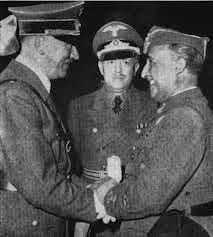
A few days after the execution of Mr Companys, on October 23, General Franco and Hitler met in Hendaye, on the border between France and Spain. Both dictators agreed to strengthen their collaboration, which had begun with the participation of the German Condor Legion in the Spanish Civil War, the bombing of Guernica—a test lab for the air raids on cities and civilians the Nazis would soon apply in the rest of Europe. And even though Spain would formally remain neutral in the Second World War, Franco decided to supply the Nazi army with the Spanish fascist volunteer Blue Division, which took part in the Russian campaign.
Almost seventy-five years later, when Germany and France have officially apologised for having participated in the arrest and deportation of Lluís Companys, the Spanish justice system continues to refuse to declare the judgement void. The Spanish state —not just Justice but also the Executive and the Legislative branches— have repeatedly opposed recognising the illegality of the Courts Martial, and has refused to meet the families of the victims: those executed, murdered, and buried in mass graves, as well as exiles, those expelled from their jobs, and those whose homes, lands, and businesses were confiscated.
While persistently refusing to recognise the Franco regime as a dictatorship —the only case of continuity of a fascist Corpus Juris or body of law anywhere in Europe— in the Spain of 2014, Franco's sarcophagus continues to preside over the mausoleum in the so-called Valley of the Fallen, which belongs to the National Heritage —i.e. the State— the Francisco Franco Foundation —devoted to exalting the values of Franco and fascism— all receive public funding every year, and the Brotherhood of the Blue Division Fighters —whose members include soldiers who fought on Hitler's side— receive diplomas of recognition from the Spanish government.
And not only that. In recent weeks we have seen the Public Prosecutor refusing to act against the display of Nazi symbols at football matches, and swastika flags at public events where police officers do not intervene. Furthermore, there have been testimonials to the Condor Legion, with the approval of local authorities and police. All this with increasingly greater impunity unheard of and unthinkable —even illegal— in European democracies.
In 2014, Spain is seeing ever greater perpetuation of the Francoism that articulated the transition in the late 70's and 80's from dictatorship to democracy, made of a pact between the old regime, the new majority parties and the powers behind government.
Upon the death of Franco, old and new politicians, under the protection of economic powers, sealed the deal that opened the way for formal rules of democracy without scrapping the essential aspects of the Franco regime. This they did in 1978 in the form of a Constitution which meant amnesty for crimes in the recent past, the perpetuation of the royal succession imposed by Franco himself, and the establishment of a system of representation with a locked in Justice system and no channels of direct participation.
This Constitution provides that the Companys sentence remains in force but prevents, they say, that the people of Catalonia can decide on their future freely, democratically. A Constitution preventing something as simple as holding a non-binding referendum.
Meanwhile, where in Madrid they carry on in denial and reneging, the Catalan authorities and Parliament, with the Government at the head, Mr Companys is honoured every 15th October, and the Olympic Stadium on Montjuïc mountain, where the castle in which he lived his last few days stands, bears his name. Perhaps because, again, it remains clear that "Catalonia is not Spain".


Josep Bargalló Valls
@josepbargallo
First Minister and Minister of the Presidency of Catalonia 2004-2006
Minister of Education of Catalonia 2003-2004
Councillor in Torredembarra Town Council (1995-2003)
President of the Ramon Llull Institute (2006-2010)
From 2010 he is Professor at the University Rovira i Virgili
More by this author:
Francesc Macià, President of the Catalan Republic

Read more »

2015/11/08

Two thousand people rally for self-government in Northern Catalonia (French State)


Catalan is not just spoken in Spain. It is also spoken in France. For decades, Catalan speakers in Northern Catalonia (as many call the part of Catalonia under French rule) have fought for their linguistic rights. Catalan is not an official language there because of the French Constitution. The government in Paris has always refused to sign the European Charter for Regional or Minority Languages (ECRML) adopted in 1992 under the auspices of the European Council. Just this month the French Sentae voted against the signing.

Northern Catalonia was annexed to France on November 7th, 1659. This date is remembered every year by Northern Catalonians in the main city of the region, Perpinyà (Perpignan). This year more than 2,000 people demonstrated for a Catalan statute, that is for self-government in Northern Catalonia. They were convoked by La Federació (a federation of organisations) and CAL (a language rights group). The march was supported by many other groups, from Catalan teachers to Sem Platform or parties as CUP or ERC.

Read more »

2015/04/04

Magnas Societas Catalanorum (The Catalan Company) in 14th century Byzantium

Roger de Flor
My acquaintance with Catalunya started with the soprano Montserrat Caballet. The magnificent lady who sang in the 1982 Barcelona Olympics with Freddie Mercury. Then I discovered that Catalunya was colonised by Ancient Greeks, who settled around the Roses area. A few miles from Roses was «El Bulli», the restaurant of Ferran Adria, another great Catalan, one of the great chefs of the world. And close to it is the ancient city of Emporion (Empuries) founded in 575 BC by Greek colonists from Phocaea with the name of Ἐμπόριον (Emporion, meaning «trading place»). It was later occupied by the Romans (Latin: Emporiæ), but in the Early Middle Ages, when its exposed coastal position left it open to marauders, the town was abandoned. I close this personal reference with Manuel Vazquez Montalban, the Catalan writer and journalist. It was not until a few days ago that I read about the Catalan Company.

Magnas Societas Catalanorum, sometimes called the Grand Company and widely known as the Catalan Company, was a free company of Almogavar mercenaries founded by Roger de Flor in the early 14th-century.


Roger de Flor

De Flor was born in 1267 in Brindisi, which was a provence of Catalonia at the time, the second son of a Brindisi’s noblewoman and German falconer named Richard von Blum (Blume means flower in German) in the service of the Hohenstaufen rulers of southern Italy.

As a boy he went to sea and became a Knight Templar.
Seal of Templar Knights


When Acre in Palestine fell to the Saracens (1291), he made his fortune by blackmailing refugees. Denounced by his grand master, he fled to Genoa and became commander of a force of almogávares (Spanish mercenaries) in service to the Aragonese king of Sicily, Frederick II, who was warring with the house of Anjou.
Coat of Arms – Hohenstaufen Family


The Almogavars

Their name is the transformation into Catalan of an Arab word, al-mogauar, which means «one who devastates». Mountain shepherds from the Pyrenees mountains of Northern Spain or forest-dwellers, these were the men who carried war to the Arab taïfa, a war made up of raids, pillaging and unstable frontiers.

They withstood the Muslim invasions of Spain in the 7th and 8th century by heading higher into the hills and fighting raider warfare in the time honored tradition of guerrillas everywhere. They were remarkable in that they were both fierce and disciplined in combat (outside combat, not so much). They could move fast through very rugged terrain, attack a Muslim settlement, and then flee before reinforcements arrived. Although they could stand against heavy cavalry, they proved very effective troops in running down the lighter Berber-style horsemen of the Iberian Muslim kingdoms.

The average Almughavar wore little to no armor, growing his hair and beards long. He carried a spear, 2 heavy javelins (called azconas), and short stabbing sword. They were the literal descendents of the Iberians that followed Hannibal into Rome, their weapons unchanged since the Romans copied them (naming them Pila and Gladius Hispaniensis).

Despite their barbarian appearance (and make no mistake, these were the hillbillies of the middle ages), the Alughavar understood two very modern principles of warfare: 1) there are no rules, and 2) defeat an enemy mentally first. Almughavars routinely held their own against European heavy cavalry because they engaged in unchivalrous tactics like aiming for a man’s horse. And before a battle, Almughavars would strike their blades against against stones, causing them to spark in the pre-dawn gloom while they chanted «Aur! Aur! Desperta Ferro!» («Listen! Listen! Iron, Awaken!»).

The battle cry of the Almogàvers

Aur! Aur! Desperta ferro!
Deus aia!
…
Veyentnos sols venir, los pobles ja flamejen:
veyentnos sols passar, son bech los corbs netejen.
La guerra y lo saqueig, no hi ha mellors plahers.
Avant, almugavers! Que avisin als fossers!
La veu del somatent nos crida ja a la guerra.
Fadigues, plujes, neus, calors resistirem,
y si’ns abat la sòn, pendrèra per llit la terra,
y si’ns rendeix la fam carn crua menjarem!

Desperta ferro! Avant! Depressa com lo llamp
cayèm sobre son camp!
Almugavers, avant! Anem allí a fer carn!
Les feres tenen fam!

Meaning:

Listen! listen! Wake up, O iron! Help us God!…Just seeing us coming the villages are already ablaze. Just seeing us passing the crows are wiping their beaks. War and plunder, there are no greater pleasures. Forward Almogavars! Let them call the gravediggers! The voice of the somatent is calling us to war. Weariness, rains, snow and heat we shall endure. And if sleep overtakes us, we will use the earth as our bed. And if we get hungry, we shall eat raw meat. Wake up, O iron! Forward! Fast as the lightning let us fall over their camp! Forward Almogavars! Let us go there to make flesh, the wild beasts are hungry!

Sicilian Vespers

Sicilian Vespers
On March 30, 1282, Peter III of Aragon waged war on Charles of Anjou after the Sicilian Vespers for the possession of Naples and Sicily. The Almogavars formed the most effective element of his army. Their discipline, ferocity and the force with which they hurled their javelins made them formidable against heavy cavalry of the Angevin armies. They fought against cavalry by attacking the enemies’ horses instead of the knights themselves. Once a knight was on the ground he was an easy victim of an Almogavar.

De Flor recruited Almogaver soldiers left unemployed with the Peace of Caltabellotta in 1302 by the Crown of Aragon who opposed the French dynasty of Anjou.

Andronicus II Palaeologus

The Battle of Bapheus occurred on 27 July 1302 between an Ottoman army under Osman I and a Byzantine army under George Mouzalon. The battle ended in a crucial Ottoman victory, cementing the Ottoman state and heralding the final capture of Byzantine Bithynia by the Turks. Bapheus was the first major victory for the nascent Ottoman emirate, and of major significance for its future expansion: the Byzantines effectively lost control of the countryside of Bithynia, withdrawing to their forts, which, isolated, fell one by one. The Byzantine defeat also sparked a massive exodus of the Christian population from the area into the European parts of the Empire, further altering the region’s demographic balance. Coupled with the disaster of Magnesia, which allowed the Turks to reach and establish themselves on the coasts of the Aegean Sea, Bapheus thus heralded the final loss of Asia Minor for Byzantium.

The Byzantine emperor Andronicus II Palaeologus had to do something about the rising threat of the Ottoman Turks.

In 1303 Roger de Flor and the Catalan Company were commissioned by the Byzantine emperor Andronicus II Palaeologus and his son the co-emperor Michael IX Palaeologus to help them fight the Ottoman Turks.
Andronicus II Paleologus (1282 – 1328),
 fresco in the Holy Monastery of Prodromos in Serres

Roger de Flor’s commission was sanctioned by the Aragonese, rulers in Sicily and southern Italy, who were quite eager to rid themselves of unemployed and unruly soldiers. Roger de Flor departed with 39 galleys and transports carrying around 1,500 knights and 4,000 Almogavars, special foot soldiers employed mainly serving the kingdom’s interests in the Mediterranean Sea, especially by the Crown of Aragon.

Roger de Flor arrived in Constantinople with the help of king Frederick III of Sicily in 1303, and married the niece of Andronicus, daughter of the Tsar of Bulgaria, and was named Grand Duke (head of the fleet).
The Catalan Company’s itineraries in Anatolia and the Balkans

Roger de Flor campaigned with his Company in Anatolia, defeating the Turks but also engaging in widespread violence and looting of the Byzantine inhabitants. By this point, the Catalans, were considered by the Byzantines to be little better than brigands and freebooters. The successes had inflated the already arrogant De Flor, leading him to entertain plans of establishing his own dominion in Anatolia.

Roger de Flor entering Constantinople

Coat of Arms of Roger de Flor
This put him at odds with the Byzantine Emperor, and the indiscipline of the Almogavars marked the end of Roger de Flor. On 30 April 1305, he was slain along with 300 cavalry and 1,000 infantry by theAlans, another group of mercenaries at the service of the Emperor. Roger had been in Adrianopolis (modern Edirne) attending a banquet offered by Emperor Michael. The emperor later attacked Gallipoli attempting to conquer the city from the remnants of the Company under the command of Berenguer d’Entença who had arrived with 9 Catalan galleys. The attack was unsuccessful, but it largely decimated the Company. Berenguer d’Entença was captured by the Genoese shortly after, and later liberated. The Company had only 206 horsemen, 1,256 foot soldiers left and no clear leader when Emperor Michael attacked, trusting in his numerical superiority, only to be defeated in Battle of Apros in July 1305.

Thus began the Catalan Vengeance. For two years, the Catalan Company raided and ravaged the Thracian countryside. They sacked Rodosto, brutally hacking apart every man, woman, and child in revenge for what was done to their brothers and their leader. Although they had no siege works and so could not sack the walled cities, no Greek army could stand against them. The emperor was forced to watch as the Catalans burnt the undefended outskirts of Constantinople. So thorough was their domination that the two year pillage of Thrace ended not because they were forced out, but because there simply was not enough places that they could pillage for food.


One fascinating episode during the vengeance was the Battle of Gallipoli. In 1306, the Catalan Company left their camp in Gallipoli and pursued the Alan force that had murdered their leader. The 9,000 Alani were fleeing north-west to their homelands. The Catalans caught up with them and butchered all but 300 in perhaps their most difficult battle.

Meanwhile, a contingent of Genoese mercenaries, at the Byzantine Emperor’s behest, attacked the poorly defended camp at Gallipoli. The Company’s quartermaster, Ramon Muntaner, had at his command 7 horsemen, 133 infantry (mostly sailors and wounded Almughavars), and all the wives of the Catalan Company. So he equipped the women and had them defend the walls under relentless Genoese crossbow barrages. One wife refused to leave her post despite being wounded five times(!) in the face(!). She stated that she would not surrender the honor of fighting in her husband’s place, except in death.

Erechteum and Frankish Tower on the Acropolis of Athens
Finally the Genoese had run out of arrows, and the general berated them for being turned back in their assault of the walls by women. Muntaner ordered his 6 remaining horsemen and 100 infantry to prepare to assault! He had them discard their heavy armor now that the enemy had run out of ammunition, and opened the gates. The surprising ferocity of their attack sent the Genoese reeling. Their general was cut down in the first attack, and the will of the attackers was broken. They fled and would have been cut down by the exhausted Catalans of Muntaner’s garrison were it not for a small company of Genoese reserves.

When the main body of the Catalan Company heard of the attack on their camp, they raced back and secured it. But now the Company was at an impasse. They had exacted what revenge they could, and the countryside was barren. Worse, despite receiving reinforcements Spain and Sicily, the lords of these reinforcements clashed with the leaders of the Company. The Catalan Company had begun to consume itself. This growing rivalry persisted as the Catalan Company decided to head west, into Thessaly and down into Greece. These struggles ended in bloodshed, and the expulsions/departure of some of the lords (including the famed Muntaner, who left more of disgust).


The Catalan Company in Athens

In 1310, Gautier or Walter V of Brienne, Duke of Athens, hired the Catalan Company to fight the Byzantine Greeks encroaching on his territory.

Coat of arms of the Aragonese Kings
After the Company had successfully reduced his enemies, he attempted to expel the Company from Athens with their pay in arrears. The Company refusing this, Walter marched out with a strong force of French knights from Athens, the Morea and Naples and Greek foot from Athens. Walter’s army met the Catalans at the Battle of Cephissus (or Halmiros or Orchomenos). On the 15 March 1311 an army of 700 Frankish Knights, 2,300 cavalry and 12,000 foot soldiers led by Walter V of Brienne, met the Catalan Company of 3,000 of which 500 cavalry. There was also a contingent of 2,000 Turks standing by, to take the side of the winners.

The day before the battle, the Company flooded the battle field with the waters of Cephissus (Kiffissos) river, and made it very difficult for the heavy knights’ cavalry to move, thus becoming prey to the agile and light cavalry of the Company.

The Catalans won a devastating victory, killing Walter and almost all of his cavalry, and seizing his Duchy of Athens, excepting only the Lordship of Argos and Nauplia.

The battle marks the beginning of the Catalan domination of Athens (1311-1388).

Coat of Arms of the Duchy of Neopatria
In 1312, the Catalan Company appealed to Frederick III of Sicily to take over the duchy and he complied by appointing his second born son, Manfred of Sicily as Duke of Athens and Neopatria. The arms seen above are those of the Aragonese Kings of Sicily under which the Duchy of Athens came. (The Duchy of Athens)

The Catalan rule was to last until 1388–1390 when they were defeated by the Navarrese Company under Pedro de San Superano, Juan de Urtubia, and allied with the Florentines under Nerio I Acciaioli of Corinth. His descendants controlled them until 1456 when they were conquered by the Ottoman Empire. By that time, like many military enterprises, the Great Company had faded out of history.


The Duchy of Neopatria 

In 1318-1319 the Catalan Company, after having conquered most of the Duchy of Athens, expanded into the territories of the Despotate of Epirus in southern Thessaly, under Alfonso Frederick, the infante of the Kingdom of Sicily. The new territories were created a duchy and united with the Duchy of Athens as new possessions of the Crown of Aragon. The Duchy was divided into the captaincies of Siderokastron, Neopatria, New Patras (modern Ypati, Υπάτη), and Salona (modern Amfissa).
The Duchy of Neopatria
Part of the Duchy’s possessions in Thessaly was conquered by the Serbs of Stefan Dusan in 1337. In 1377, the title of Duke of Neopatria was assumed by Peter IV of Aragon. It was preserved among the subsidiary titles of his successors, and is still included in the full title of the Spanish monarchs.

The attacks of the Byzantine Empire progressively diminished the territory of the duchy until what was left of it fell completely into the hands of the Republic of Florence in 1390.

The Catalan Chronicle

Ramon Muntaner, one of the ringleaders of the Catalan Company’s expedition, recounted the adventures of the Almogaver army in the eastern Mediterranean in his Chronicle.
Manuscript of the Catalan Chronicle

Ramon Muntaner (1265-1336) began to write the Crònica in 1325, at his estate of Xilvella, some sixteen years after leaving the Almogavars, and probably finished some three years later, in 1328. Muntaner’s Crònica is presented as an autobiography (in which the writer from Peralada takes on the role of counselor and political-military strategist) and, at the same time, as an historic memoir of the past of his kings (in order to justify the politics of the Crown of Aragon, the glorious past of the kingdom, and the even better future that must arrive), in which Muntaner appears as a exemplary and proud subject. (Xavier Bonillo Hoyos)

«The Catalan Chronicle is a vitally important source for warfare in northwestern Asia Minor and the eastern Balkans in the early 14th century. The author, Muntaner, was secretary and paymaster of the Catalan Company, an experienced mercenary formation that had previously fought in Sicily. His account is particularly important because, as paymaster, Muntaner had accurate daily figures at his disposal of the numbers of troops in the Company and gves plausible information about logistic problems, i.e. the acquisition of grain, other foodstuffs and fodder. The relative size of armies and their supply needs can therefore be computed from his figures with a degree of accuracy, as also casualties. There are other details often omitted from the standard accounts that deserve particular attention from Byzantinists. Firstly, the Catalans had brought their families with them to the Byzantine empire. Their ruthless fighting methods were thus a consequence of the fact that they were endeavouring to ensure the survival of a whole society that had migrated inside the frontiers of the Byzantine state. Secondly, it is apparent that the Catalan Company became the rallying point for many disaffected people who joined their fighting forces. Among them were dispossessed Greek soldiers and peasants, as well as clans of Turkish fighters from Asia Minor, who trusted the honesty of the Catalans more than that of their own political and military elites. The Catalan Company owed its successful recruitment of men to a range of grievances against the Byzantine state and its co-emperors, Andronikos II and Michael IX Palaiologos, who in Mutaner’s view had betrayed the original treaty and chrysobulls placing the Compnay under Byzantine authority. The Catalan Company was to some extent an experiment in multi-ethnic military democracy based on talent, courage and mutual need, in constrast to the divisive and grasping aristocratic politics of the Byzantine system. Third, Muntaner provides important indications about the laws of war. After Michael IX’s assassination of Catalan leader Roger de Flor, the Company challenged emperor Andronikos II to judicial combat, consisting of one, or ten, or a hundred champions on each side–the first examples of which date from the reign of the previous emperor, Michael VIII Palailogos. It is a good example of how the employment of western ‘barbarian’ mercenaries resulted in the modification (or perhaps hybridization) of the Byzantine law of war to accomodate the ‘barbarian’ systems of customary law that existed outside medieval Graeco-Roman positive and customary legal practice. «(Amazon, Dr. F. R. Trombley) 

Read more »

2015/02/09

Interview with the Coronela (Barcelona's militia) taylor

As Catalonia moves to recover her freedom, lost by force of arms in 1714, she is also working hard to recover her military traditions and values. Liberty and responsibility are but two sides of the same coin, one cannot exist without the other, and any nation seeking to rejoin the international community as a free and equal member must be ready to do her duty when it comes to contributing to peace and security. One of the aspects of Catalonia's normalization is the return of the Coronela, her capital's militia, currently in the shape of a military re-enactment group, with the support of Barcelona City Council.

The "Coronela": Barcelona City's Militia. Made up of reservists, civilians under military discipline when called up to serve. Manning was in the hands of the city's guilds, while responsibility for equipment was shared with the Crown. Each guild provided the personnel for a company. The Coronela expanded to five battalions during the War of Spanish Succession (1701-1714), in which it played a key role in the defence of Barcelona. Other Catalan towns had similar units.

One of the key aspects of military re-enactment is the provision of accurate, historically faithful, uniforms. The following is a brief interview with Maria Victòria Verderes i Blach, who serves as taylor for the Coronela.


What is the main difficulty involved in tailoring historical uniforms?

The main one is being faithful to their design and function. The reason is that they were not just a dress to cover one's body. Instead, many also served to protect weapons, for example.
Another problem is the difficulty in finding certain items. For example, it is nowadays difficult to find stripes of a colour resembling copper, or rusty metal, which were in widespread use at the time. What we then do, in order to get this tone, is to dye them with copper-colour shoe cream. We also try not to make the excellent sewing machines we currently enjoy conspicuous. We rather try to hand-sew as much as we can. Whenever possible, we follow the patterns that we are lucky to still find, half lost and half buried, in for example some Italian museums, translating their contents to a comprehensible language.

Are you happy about your work with La Coronela?

I have only spent a short time cooperating with this institution, but I am very proud of being able to contribute with my work to help a group of people passionate about history, to make known to the public a series of deeds that until now had been buried and forgotten. Above all, we are motivated by a Patriotic feeling, a duty towards our country, so many times treated unjustly. La Coronela's goal is to reach 3,000 members, as the city guilds used to bring together united by the same wish: to fight to defend our liberties!


Are you sensing a growing interest in Catalonia's military heritage, uniforms included?

I can feel a growing interest in our historical heritage, indeed, and not just our military heritage. More widely, in our traditions, be they dances, cuisine, customs, festivals... However, what the Coronela wants to avoid is to be considered part of Catalan folklore, since we are trying it to be what it used to be: an organization under military discipline, with military ranks and rules. We want the Coronela to become, in the future, the city's honorary guard. This would amount to paying homage, 300 years later, to all those who made the ultimate sacrifice to defend Catalonia from the overwhelming attack by absolutist forces.


Read more »