2018/11/18

The Catalan Company 1302 AD – 1388 AD

Charles of Anjou with a French army invaded Italy and conquered the Kingdom of Sicily in 1266, losing the island of Sicily in the War of the Sicilian Vespers from 1282, but retaining the Kingdom of Naples for his heirs. 

In 1282 the Sicilians revolted against Charles, massacred his French supporters and invited Pere III of Aragon to rule them. Bringing a force of Aragonese and Catalans, he fought the War of the Sicilian Vespers. Peace in 1301 left Sicily in Aragonese hands, Naples in Angevin hands and a dangerous surplus of Catalans, soon transferred to Byzantine service as the notorious Catalan Grand Company.

The Catalan Grand Company from its departure from Sicily until the fall of the state it founded in Greece to the Florentines. During this time it fought for both Byzantines and Romanian Franks, was short-changed by both, took a horrid revenge on both, and beat every Turkish, Byzantine and Frankish army that got in its way. Its Alan allies were allied only because hired by the Byzantines to assist the Grand Company. The relations between the two ranged from veiled hostility to naked hostility. After the Byzantine assassination of its great leader Roger de Flor, the company was largely commanded by committee, often through a figurehead. It is said to have been highly disciplined, although displaying extremely rapacious behaviour towards even friendly civilians. Despite having left Aragonese service under a cloud after backing the wrong heir, the Company continued to fight under the banner of Aragon [yellow with horizontal red stripes].

The Catalan companies in the East. – Andronicus could not master the situation without foreign aid, and he got such aid from the Catalan mercenary bands, the so-called “Catalan companies,” or “almughavars.” Mercenary bands of various nationalities, under the name of “companies,” which lived only for war and would fight for pay for anyone against anyone, were very well known in the latter half of the Middle Ages. “The Catalan companies,” which consisted not only of Catalans, but also of the inhabitants of Aragon, Navarre, the island of Majorca, and other places, fought as mercenaries on the side of Peter of Aragon during the war which burst out after the Sicilian Vespers. When at the very beginning of the fourteenth century a peace was concluded between Sicily and Naples, the Catalans were out of work. Such allies, accustomed to war, pillage, and violence, became in time of peace dangerous to those who had invited them, and who now tried to get rid of them. Moreover, the companies themselves, finding no satisfaction in peaceful living conditions, sought new opportunities for activity. The Catalans chose for leader Roger de Flor, a German by origin, whose father’s surname, Blum (i.e. a flower), was translated into Catalan as “Flor.” 

With the consent of his companions Roger, who spoke Greek fluently, offered his services to Andronicus II for his struggle with the Seljuq and Ottoman Turks and extorted from the hard pressed Emperor unheard-of conditions: the insolent adventurer demanded the consent of Andronicus to his marriage with the Emperor’s niece, the granting of the title of megadukas (admiral), and a large sum of money for his company. Andronicus was compelled to yield, and the Catalan companies took ship and sailed for Constantinople.

The participation of the Catalans in the destinies of Byzantium is narrated in detail both in the Catalan sources and in the Greek. But while a participant of the expedition, the Catalan chronicler Muntaner described Roger and his companions as courageous and noble fighters for a right cause, a credit to their country, Greek historians consider the Catalans pillagers and insolent ruffians, and one of them exclaimed: “Would that Constantinople had never seen the Latin Roger!” Historians of the nineteenth century devoted much attention to the Catalan expedition. A Spanish investigator of the problem compared their deeds with those of the famous Spanish conquerors of Mexico and Peru in the sixteenth century, Cortez and Pizarro; he does not know “what other people may plume themselves on such a historical event as our glorious expedition to the East,” and he considered the expedition an eternal testimony to the glory of the Spanish race. 

The German historian Hopf declared that “the Catalan expedition is the most attractive episode in the history of the Empire of the Palaeologi,” especially on account of its dramatic interest. Finlay wrote that the Catalans “guided by a sovereign like Leo III or like Basil II, might have conquered the Seljuq Turks, strangled the Ottoman power in its cradle, and carried the double-headed eagle of Byzantium victorious to the foot of Mount Taurus and to the banks of the Danube.” 
Elsewhere the same historian remarked: “The expedition of the Catalans in the East is a wonderful instance of the success which sometimes attends a career of rapacity and crime, in opposition to all the ordinary maxims of human prudence.” The Spanish archives still afford much new information on this expedition.

At the very beginning of the fourteenth century Roger de Flor with his company arrived in Constantinople. There were almost ten thousand members of the expedition; but this number included wives, mistresses, and children. The marriage of Roger to the Emperor’s niece was celebrated at Constantinople with great pomp. After some serious conflicts in the capital between the Catalans and Genoese, who, jealous for their exceptional privileges in the Empire, felt the newcomers their rivals, the company was finally transported into Asia Minor, where the Turks were besieging the large city of Philadelphia, east of Smyrna. Supported by a band of imperial troops the small Hispano-Byzantine army, under Roger de Flor, freed Philadelphia from the Turkish siege. The victory of the western mercenaries was enthusiastically received in the capital; some men thought that the Turkish danger to the Empire was over forever. 

The first success was followed by others against the Turks in Asia Minor. But the unbearable extortions and arbitrary cruelties of the Catalans towards the local population, on one hand, and the clearly expressed intention of Roger to establish in Asia Minor a principality of his own, though under the Emperor’s suzerainty, on the other, strained the relations between the mercenaries, the people of Asia Minor, and the government of Constantinople. The Emperor recalled Roger to Europe, and the latter with his company crossed the Hellespont and occupied first an important fortress on the straits of Gallipoli, and then the whole peninsula of Gallipoli. The new negotiations between Roger and the Emperor ended in Roger’s obtaining the title next to the Emperor’s, that of Caesar, never till then borne by a foreigner. Before marching again to Asia Minor the new Caesar went with a small band to Hadrianople, where the eldest son of Andronicus, the co-emperor Michael IX, resided. On Michael’s instigation, Roger and his companions were slain during a festival. When these tidings spread among the population of the Empire, the Catalans in the capital and other cities were also murdered. 

The Catalans, who were concentrated at Gallipoli, inflamed and thirsty for revenge, broke their obligations as allies of the Empire and set out to the West, ravaging with fire and sword the regions through which they passed. Thrace and Macedonia were terribly devastated. Not even monasteries on Mount Athos were spared. An eyewitness, a pupil of Daniel, igumen (abbot) of the Serbian monastery of Chilandarion, on Mount Athos, wrote: “It was horror to see then the desolation of the Holy Mountain by the hands of enemies.” The Catalans also burned the Russian monastery of St. Panteleemon, on Mount Athos, but their assault on Thessalonica failed. In retaliation for the Catalan devastations Andronicus commanded the merchandise of some Catalan vessels in the Byzantine waters seized and the merchants themselves arrested.

After having stayed some time in Thessaly, the Catalans marched to the south, through the famous pass of Thermopylae, into middle Greece to the territory of the Duchy of Athens and Thebes, which had been founded after the Fourth Crusade and was under French control. In the spring of 1311 there took place a battle in Boeotia, at the river of the Cephisus, near the Lake of Copais (near the modern village of Skripù). The Catalans won a decisive victory over the French troops. Putting an end to the flourishing French duchy of Athens and Thebes, they established there Catalan control which lasted for eighty years. The church of the Holy Virgin, the ancient Parthenon on the Acropolis, passed into the hands of the Catalan clergy, who were impressed by its sublimity and riches. In the second half of the fourteenth century a Catalan duke of Athens called the Acropolis “the most precious jewel that exists in the world, and such as all the kings of Christendom together would imitate in vain.”

The Athenian Duchy of the Catalans established by mere accident in the fourteenth century and organized upon Catalan or Sicilian models, has generally been considered a harsh, oppressive, and destructive government, which at Athens and in Greece in general has left very few material traces of its domination. On the Acropolis, for instance, the Catalans carried out some changes, especially in the disposition of the fortifications, but no traces of them remain. But in Greek popular tradition and in the Greek tongue there still linger reminiscences of the cruelty and injustice of the Spanish invaders. Even today, in some regions of Greece, for example, in the island of Euboea, a man in condemnation of illegal or unjust action may say: “Not even the Catalans would have done that.” In Acarnania to the present day the word “Catalan” is the synonym for “savage, robber, criminal.” At Athens the word “Catalan” is considered an insult. In some cities of the Peloponnesus, when one wishes to say that a woman possesses a bad character, one says, “She must be a Catalan woman.”

But recently much new material, especially in the Archives of Barcelona (the archives de la Corona d’Aragó), has come to light which shows that the conception of former historians on this subject was biased. The years of the Catalan domination in middle Greece in the fourteenth century were not only troubled and destructive; they were productive. The Acropolis, which was called in Catalan Castell de Cetines, was fortified; for the first time since the closing of the Athenian school by Justinian the Great, a university was established at Athens. 
Catalan fortifications were also erected in middle and northern Greece. A modern Catalan historian, the best recent authority on the Catalan problem in Middle Greece, A. Rubió y Lluch, declared, “The discovery of a Catalan Greece is, in our opinion, one of the most unexpected surprises the modern investigators have had in the history of medieval political life.” Of course, the full story of the Catalan dominion in Greece remains to be learned; but we must realize that the older works and former opinions on this problem of many very eminent scholars must be rectified, and that a new history of the Catalan dominion in Greece must be told on the basis of new material. 

Read more »

2018/06/14

"Catalan process is not populist", states Meindert Fennema, expert in European populism

The Emeritus Professor at the University of Amsterdam and political scientist, Meindert Fennema, spoke with the CNA about the Catalan independence process. According to this recognized expert in populism throughout Europe, the Catalan process is far from populist, and he explains why such a comparison is false. Not only are the historical roots of both very different, but while populism "started as an anti immigration movement", "for historical reasons, Catalans have always embraced their immigrants". Moreover, populism is traditionally anti-government and against European Union integration; "a populist would not trust any government, neither Madrid nor the Generalitat (the Catalan Government’s official name)", he emphasized. 

Meindert Fennema
However, the Catalan independence movement has always been democratic, supportive of granting more powers to the Catalan Government and open to inclusion within Europe. Dr. Fennema goes onto debunk the myth that the Catalan independence movement is similar to the stance adopted by the French populist and extreme-right party Front National, headed by Marine le Pen; although this is a myth spread by a small minority. The Dutch expert pointed out that given the religious and political differences it is "nonsensical" to say that the Catalan movement looks like Le Pen’s; it is "not true", he insisted. He admits that there are elements of radicalization in Catalonia’s independence movement; however he explains that they represent a small part and they come from the "fringe" aspect of being a cultural and linguistic minority, like that of the Frisian movement in his home country The Netherlands. Finally, he explains why Spain is a more corrupt country than Holland, and how best to fight against corruption today. 


The Catalan process has on many occasions been likened to populist movements by Spanish nationalists, who have even compared it to Nazism. The MEP of the Spanish nationalist UPyD party, Beatriz Becerra, sent a letter on October 8 to the 751 Members of the European Parliament in which she compared the Catalan self-determination process with what happened in "Italy and Germany during the twenties and thirties of the twentieth century." Following this incident the German MEP Ingeborg Grässle, told the that they asked the UPyD MEP for an apology for using an "inappropriate and false" simile and because to "trivialize" Nazism "is a disgrace to victims".

Only a few weeks later the leader of the Catalan Socialist Party (PSC), Miquel Iceta, made a similar comparison regarding the plebiscite elections that the President of the Catalan Generalitat ,Artur Mas, is planning to call as ‘de facto’ referendum on independence taking into account the Spanish Government’s blocking attitude for a mutually-agreed vote,. According to Iceta, the plebiscite “reminded him” those elections behind the rise of Adolf Hitler in 1933. The PSC leader, however, later corrected this and said that "any comparison with Nazism is not accurate."

These comparisons are inadequate for Fennema and even "ridiculous". According to the Dutch Emeritus Professor, the Catalan independence movement cannot be described as populist, and his first reason is that the two share very different attitudes towards immigration.

"For historical reasons, Catalans have always embraced their immigrants"

While "populism started as an anti immigrant movement" and became later "anti European" with a common ground in "nationalism", the Catalan movement, on the other hand, was pro-immigration. Furthermore, Spain "had always exported labour rather than imported it", making inclusion with Europe advantageous. Fennema points out that "for historical reasons, Catalans have always embraced their immigrants", inducing them to "learn Catalan and become Catalan". He argues that this "open-minded strategy" to including immigrants within Catalonia is very different to one adopted by a populist movement. He points out it is a mutually-advantageous relationship, given that "the biggest enemy of Catalonia is Madrid", so any one with a similar attitude "is welcomed”. Moreover from the other perspective, "immigrants would benefit from more independence, because Catalonia is a fairly wealthy nation", and the "rest of Spain is not".

"A populist does not believe in any government, neither Madrid nor the Generalitat"

Not only are the historical roots and attitude to immigrants very different, but the Catalan process is far from populist in its attitude to government. While the Catalan process seeks self-governance, European populism is anti governments of any kind. He admits that "there may be populists in Catalonia" but "most Catalan parties are not populist".

The Catalan process has also been compared to extremist political parties, including that of the French far-right party Front National, led by Marine Le Pen. Dr. Fennema rejects this comparison however, pointing out that to say that because both are "nationalist" does not make them the same, this is a simplistic comparison. "It is very nonsensical to say that since the Catalan movement is a nationalist movement and Le Pen is a nationalist movement", they are similar; "that is not true". He explains the two movements have different political and religious backgrounds; "actually Catalan nationalism is very republican" unlike the Front National, and while the latter has "very strong catholic roots" in contrast to the Catalan movement.

If anything, the Catalan process is better compared to one of an ethnic minority, and he uses the Frisians of his home country The Netherlands as an example. "The Frisians have always had a good contact with the Catalans", according to the Dutch Emeritus Professor, as both are "a cultural minority". While there may be "elements of radicalization" in both, he feels this to be a "fringe aspect" and represent a minority within these movements.

European populists are "ethnic nationalists" opposed to the"transfer of power to Brussels"

Fennema identifies European populists as being "ethnic nationalists" who want to close their borders to immigration, and do not want their nation to "transfer power to Brussels". This is unlike what is happening in Catalonia, which has an open stance towards immigration and wants to increase European political and economic integration. This definition fits more the attitudes of parties such as the Front National, or the UKIP party of Nigel Farage in the UK, which share similar views regarding immigration and corruption policies. For Fennema, and other experts in the field, such as Sarah de Lange and Sjoerdje van Heerden, authors of the book 'Not that different after all: radical right parties and voters in Western Europe', it is a mistake to simply warn the public of the dangers of such attitudes, what is needed is to understand why they are gaining popularity and now they are being treated as "normal". Another dangerous consequence of this, the experts point out, is that as the right-wing becomes more mainstream, the centre parties are being pushed into more radical policies in order to maintain the balance.

Regarding their presence in the EU, UKIP, (which has representation in the British parliament) is in the Europe of Freedom and Democracy group in the European Parliament, shared with the Italian Five Stars Movement, led by David Borelli. This October, the Euro-sceptics were about to lose their place when a MEP left, leaving them short of the 7 members of different countries required for representation. In the end however, the position was maintained when Polish MEP Robert Jaroslaw Iwaszkiewicz joined his party with those of Farage and Borrelli. However, Marine Le Pen did not join and she simply shares an operational budget with a few other MEPs.

Spain "was always focused on becoming a part of Europe" 

Fennema recalls that the particularities of Spain mean that the profiles of the Front National or UKIP cannot be applied to Spanish parties. This is both because Spain "was always focused on becoming a part of Europe", and also because unlike England and France, it has "always been a country which exported labour rather than imported it". Moreover, the very different history makes the two incomparable; the experience of the Civil War and Franco’s dictatorship were key to preventing the rise of populism in Spain, said the Emeritus Professor, "because the Spaniards do not want any other kind of extremism". He concludes that while the "Partido Popular [People’s Party] is a legacy of Francoism, yet it has always behaved democratically", though "not always completely" he adds.

"Corruption is stronger in Spain... because in Holland we have stronger institutions"

The rise of populism could be explained by citizens losing confidence due to corruption increasingly leading states. In conclusion, Dr. Fennema compared corruption within Spain and his national Holland. In his opinion, strong institutions are key: there is more corruption in Spain, "not because Spanish people are worse or more immoral than Dutch people" but because "in Holland we have stronger institutions". The expert from the University of Amsterdam believes it is through "checks and balances" that we must lead the way forward, to "struggle against corruption by establishing strong institutions that check each other". 

Related articles:

Comparing Catalonia's self-determination democratic process with the Nazi regime has become one of the arguments the Spanish nationalists have been using over the last two years, repeated in extreme-right television stations and even at the Spanish Parliament. Such an offensive and dishonest comparison outrages most of the Catalan society because of its total unfairness in describing the current democratic and peaceful self-determination process and for trivializing Nazism and the suffering of its victims – including hundreds of Catalans who died in concentration camps. Now, the controversy has reached the European Parliament. Read more....

Help Catalonia is an association that receives no subsidies whatsoever from the Spanish state, the Catalan government or indeed any other organisation. We, the people who work in this project, do so on a voluntary basis and for no financial gain whatsoever.
If you like the task we are performing and would like to help us carry on our undertaking you may make a donation through bank account No. IBAN ES69 0049 4751 4421 9506 0811 
Or you may also make a donation via PayPal clicking the button "Donate" . THANK YOU

Read more »

2015/01/23

First Times in Catalonia


Prehistory in Catalonia
Urnfield Culture in northeast Iberia,
Late Bronze Age, c. 1300 BCE

The first known human settlements in what is now Catalonia were at the beginning of the Middle Palaeolithic. The oldest known trace of human occupation is a mandible found in Banyoles, described by some sources as pre-Neanderthal some 200,000 years old; other sources suggest it to be only about one third that old. Some of the most important prehistoric remains were found in the caves of Mollet (Serinyà, Pla de l'Estany), the Cau del Duc in the Montgrí mountain ("cau" meaning "cave" or "lair"), the remains at Forn d'en Sugranyes (Reus) and the shelters Romaní and Agut (Capellades), while those of the Upper Paleolithic are found at Reclau Viver, the cave of Arbreda and la Bora Gran d'en Carreres, in Serinyà, or the Cau de les Goges, in Sant Julià de Ramis. From the next prehistoric era, the Epipaleolithic or Mesolithic, important remains survive, the greater part dated between 8000 BC and 5000 BC, such as those of Sant Gregori (Falset) and el Filador (Margalef de Montsant).

The Neolithic era began in Catalonia around 4500 BC, although the population was slower to develop fixed settlements than in other places, thanks to the abundance of woods, which allowed the continuation of a fundamentally hunter-gatherer culture. The most important Neolithic remains in Catalonia are the Cave of Fontmajor (l'Espluga de Francolí), The Cave of Toll (Morà), the caves Gran and Freda (Montserrat) and the shelters of Cogul and Ulldecona.

The Chalcolithic or Eneolithic period developed in Catalonia between 2500 and 1800 BC, with the beginning of the construction of copper objects. The Bronze Age occurred between 1800 and 700 BC. There are few remnants of this era, but there were some known settlements in the low Segrezone. The Bronze Age coincided with the arrival of the Indo-Europeans through the Urnfield Culture, whose successive waves of migration began around 1200 BC, and they were responsible for the creation of the first proto-urban settlements. Around the middle of the 7th century BC, the Iron Age arrived in Catalonia.


The rise of Iberian culture

During the period of Iberian civilization, the Catalan territory was home to several distinct tribes: the Indigetes in Empordà, the Ceretani in Cerdanya and the Airenosins in the Val d'Aran. The influx of Celtic peoples led to a characteristic blend of cultures known as Celtiberian, which was affected by the first arrival of colonists from Ancient Greece and Carthage; like the rest of the Iberian Peninsula, Catalonia participated in what became the Iberian culture. At this time Empúries (originally Greek Emporionmarket, then Emporiae), on the coast of what is now the Catalan province of Girona, a commercial enclave, founded from the Greek city of Phocaea in the 6th century BC.

From the 8th century BC to the 7th century BC the indigenous peoples came into contact with the colonizers, and the first iron objects are found in the area. From the 7th century BC to the middle of the 5th century BC, the process of Iberianization was consolidated. A period of plenty lasted from the middle of the 5th century BC until the 3rd century BC. Finally, after the 218 BC arrival of the Romans, the Iberian culture was absorbed into that of Rome.

Roman times
Roman conquest and
the provinces of Roman Hispania

Romanization brought a second, distinct stage in the ancient history of Catalonia. Gnaeus Cornelius Scipio Calvus arrived in Empúries, with the objective of cutting off the sources of provisions of Hannibal's Carthaginian army during the Second Punic War. After the Carthaginian defeat, and the defeat of various Iberian tribes who rose up against Roman rule, 195 BC saw the effective completion of the Roman conquest of the territory that later became Catalonia and Romanization began in earnest. The various tribes were absorbed into a common Roman culture and lost their distinct characteristics, including differences of language.

Most of what is now Catalonia first became part of the Roman province of Hispania Citerior; after 27 BC, they became part of Tarraconensis, whose capital was Tarraco (now Tarragona). The arrival of Roman administrative and institutional structures led to the development of a network of cities and roads, the adoption of agriculture based on cereals, grapes, and olives, the introduction of irrigation, the development of Roman law, and the adoption of the Latin language.

Read more »

2015/01/21

Sardana


The Sardana is a traditional Catalan dance which is danced in a circle while holding hands, and is native to the Spanish region of Catalonia. It originated in the historical region of Empordá, in the North-east of the Catalan region, 
Sardana

While the date of the origins of this Spanish dance is unclear, as some people believe that the Sardana was already very popular as early as the 16th Century, what is clear is that it was popular in Empordá in the latter part of the 19th Century. The 19th Century saw the Sardana exploding in popularity, carrying it across the Catalan region. The Sardana became so famous that it came to stand for Catalan identity and nationalism after the 'Renaixença' (Renaissance) in Catalonia at the beginning of the 19th Century.

After the Spanish Civil War, and the arrival of the dictatorship of General Francisco Franco, the Sardana, along with many other regional traditions, was banned for being a symbol of the Catalan identity and nationalism. In 2010 however, the Catalan government declared that the Sardana was worthy enough to be added to their list of Catalan festivities and made it a dance of national interest.

The music that accompanies the Sardana is played by a 'cobla', the name of the Sardana band. This band consists of ten wind instruments, a double bass and a small drum called a 'tamborí'. Five of the wind instruments are woodwind instruments which include a small flute-like insruments called a 'flabiol', and two of both the 'tenora' and 'tible' which belong to the same musical family as the oboe. The other five wind instruments are brass instruments which include two fiscorns which are a type of saxhorn, two trumpets, and a trombone. Today there are over a hundred 'coblas' in Catalonia.

The music itself tends to be focused around a 6/8 rhythm, which Pep Ventura's band is credited for stabilizing, yet it can also be performed in 2/4. It consists in two sections or 'tirades' which are repeated in a pattern to produce the full length song for the dance. The two sections are called 'curts' (short steps) and 'llargs' (long steps).

A Sardana normally begins with an 'introit' which is an introduction played by the 'flabiol'. Then the 'tamborí' is tapped once to let the dancers know that it is time to start the dance. Normally, the dancers then perform the 'curts' which are short steps with the arms down. The 'llargs' then follow which are long steps with arms at shoulder height. These sections are then repeated in a pattern before the 'contrapunt' which is sort of an intermission section, again played by the 'flabiol'. Another set of 'llargs' are performed before the final part of the dance. The dance ends with the 'cop final' (final beat) where all the Sardana dancers, also called 'sardanistes', stop with one unified movement.


Being a circle dance, the Sardana is very variable, especially in terms of the number of dancers. Often when a Sardana begins to be performed in a street or at a party, people come along and join in, hence the circle gets bigger and bigger. Normally, people in the circle alternate in gender, i.e. man, woman, man, woman. 

Professional dancing troupes of Sardanas also exist and are called 'colles'. These organized groups tend to have their own costumes or outfits which are specific to their 'colla'. For example, the 'Colla Estol-Espígol', a group from Agramunt, to the West of Barcelona, wear white clothes with green saches, belts, gloves, trousers and shoes.


Forget flamenco – Catalonia’s all about the sardana


Picture the scene… You’re on holiday in Catalonia, strolling down the street, soaking up the vibe and minding your own business. You round a corner and stumble across a group of people in a circle holding hands, tapping their heels and from time to time throwing their hands up in the air. Congratulations! You have chanced upon the traditional...
Read more »

Read more »

2015/01/19

Tarraco

(3rd Century BC - 5th Century AC) The Romans turned Tarraco into one of the most important cities of Hispania. They bequeathed to us important monuments that, in 2000, were declared Patrimony of Humanity by UNESCO.


Before the arrival of the Romans, Tarraco was a fortified Iberian village called Kese. Its strategic situation, on a coastal hill next to the mouth of the river Tulcis (today Francolí), attracted the Roman armies, who turned it into their military base between the years 218-206 B.C., during the Second Punic War.

The Romans surrounded the fortress with walls built of great blocks and towers having interior rooms: the highest tower was decorated with a relief of the Goddess Minerva. Inside, was found the oldest known Latin inscription discovered to date in Roman Hispania: ‘Mn Vibio Mnerva’, which is a dedication from ‘Manius Vibius’ to the goddess Minerva.

Soon, Tarraco turned into the New Cartago, that is, the great communications port with Italy, and the door to the Ebro valley and the interior of the Iberian Peninsula. At the end of the second century B.C., the city was urbanised, the drains were outlined, the streets were organised, and a capitulary temple was built that presided the first forensic square. The richest citizens ordered the construction of luxurious ‘domus’, which were paved with mosaics of ‘opus signinum’, and impressive tower-shaped mausoleums decorated with statues in the Italic style.

Towards 45-49 B.C., Julius Caesar awarded Tarraco the title of colony (Iulia) ‘Urbs Triumphalis Tarraconensis’. Years later, between the years 27 and 25 B.C., another emperor, Augustus, chose it as a place to recover from a grave illness while the Roman legions fought in the Cantabrian wars. The importance of the city was on the increase and its competences were also growing. It became the capital of the new province of ‘Hispania Citerior’ or ‘Tarraconense’, which was the head of a judicial district (‘conventus iuridicus’), headquarters of the governor and procurator, treasury and provincial records.

An assembly of notables governed the colony and amongst the population there were free citizens, slaves, freed slaves, and foreigners. The Roman ‘villae’ of the surrounding areas started to produce wines of superior quality, which were much esteemed in Italy.

Round about the turn of the era, the imperial cult was in full apogee and monuments were erected that venerated the Roman emperors: a grand altar dedicated to Augustus was constructed during his lifetime. After his death, in 14 A.C., another enormous temple, constructed of white marble with eight Corinthian columns on its facade, was erected in his honour: the temple was built at the top of the city and within its interior was kept a gigantic figure of god Augustus enthroned like Jupiter. The coins of the city recorded both monuments.

The forum, which was built in the lower part of the city, next to the grand port protected by a breakwater of pillars, progressively widened over the years. Within it was erected a juridical basilica of three naves, in which trials were held. Nearby, the Romans built a grand theatre of faced, local stone. The scenic facade was decorated with statues of Augustus and his heirs. Over time, the facade would be restored and, during the first and second century A.C., new statues were added, dedicated to successive emperors.

Running water came to the thermal baths and the houses from the rivers Francolí and Gaia, through two pipes and aqueducts, similar to that which is still conserved at the Ferreres: it is a grand construction of ashlars, 200 metres long and 26 metres high, with two superimposed arches of 11 and 25 spans, respectively. The local stones, tiles and calcareous rocks were obtained from the quarries close by, such as those known as Mèdol, Santa Tecla and Alcover.

The Augusta road, which communicated with Cadiz and Rome, and was the origin of the other roads that united the coast to the interior of the peninsula, passed through Tarraco. The funerary buildings, like the ‘Torre dels Escipions’ [Tower of the Escipions], a family tomb from the first century A.C., and the commemorative monuments, such as the ‘arc de Berà’ [Berà arch], which was erected on the road by assignment of the tycoon Licini Sura, marked the boundary of these paved arteries at their point of entrance to the city limits.

With the arrival to power of the Flavis emperors, the city started to celebrate an annual grand assembly of delegates from all over the province, called the ‘concilium provinciae Hispaniae citerioris’. In these encounters, cult was rendered to the emperor, and the ‘flamen’ of the ceremonies was chosen. For the ceremony, an enormous provincial forum was constructed in the surroundings of the old temple of Augustus. The new forum had a precinct of cult, a gigantic square for performances with a great profusion of statues – there was not another in the whole of the Roman world that surpassed its dimensions – and an annexed circus that was built inside the city. The circus is one of the most unique bequeaths that the city of Tarragona has preserved from its Roman past. The frontispiece was restored and, nowadays, many of its arches are occupied by houses and shops.

Between the years 121-122 A.C., the emperor Adrian restored the temple of Augustus and convened a grand assembly of the three provinces of Hispania. On the outside of the city a grand amphitheatre was constructed to hold the gladiatorial combats and the hunting of wild animals. Terraces and tiers of seats cut into the rock, or constructed upon grand arches, allowed the separation of the public from the sand bed by a high podium.

Tarraco lived one of its most splendid periods throughout the first and second century A.C. The most powerful residents lived in the grand ‘villae’ of ‘otium’, built on the outskirts of the city, and were surrounded by many luxuries. The rich Roman citizens, who were able to build great residencies, like those that have been discovered at ‘Munts’ in Altafulla, had big thermal baths and salons with three seating beds having mosaic pavements, mural paintings and decoration with statues. Next to these luxurious houses there were other ‘villae’ and small hamlets (‘pagi’, ‘vici’), dedicated to agricultural and livestock production.

In 259 A.C., Bishop Fructuós and his deacons Auguri and Eulogi were martyred in the amphitheatre. When the Roman emperors decided to allow the Christians free cult, an enormous paleo-Christian necropolis was erected alongside their graves, next to the Francolí River, with mausoleums, sarcophagi and humble tombs of amphorae or tiles. In the Visigoth period a basilica was erected in the amphitheatre, in the same place as the Bishop and his deacons were martyred.

Tarraco continued to be an important city throughout the fourth and fifth centuries A.C.: in Centcelles villa (Constantí), a rich local person, who had converted to Christianity, was buried in a luxurious mausoleum under a cupola decorated with polychrome mosaics: it was so splendorous that for years it was believed to be the tomb of an emperor.

In 2000, UNESCO recognised the Roman monuments to be Patrimony of the Humanity. In the National Archaeological Museum of Tarragona and the History Museum of Tarragona, architectural, ceramic, glass and metal elements are preserved, as well as a collection of more than 1.200 tombstones, which is considered to be the most important in the whole of the Iberian Peninsula.

Read more »

2015/01/15

Almogavars and the Catalan Company

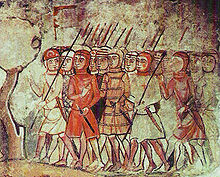
Almogavars is the name of a class of soldier from many Christian Aragon-Catalonia kingdoms in the later phases of the Reconquista, during the 13th and 14th centuries. Almogavars were lightly clad, quick-moving frontiersmen and foot-soldiers. They hailed from the Kingdom of Aragon-Catalonia and Kingdom of Valencia. At first these troops were formed by farmers and shepherds originating from the countryside, woods and frontier mountain areas. Later, they were employed as mercenaries in Italy, Latin Greece and the Levant.

Saracen origin of the term

The term was first used in the 10th century in the territory of Al-Andalus, to refer to small armed groups of Saracens engaged in looting and surprise attacks. The first documented historical reference appeared in the chronicle "Akhbar muluk Al-Andalus" or "Chronicle of the Moor Rasis", the history of the kings of Al-Andalus, written between 887 and 955 by Ahmad ibn Muhamad Ar-Razi, known among Arabs by the name Al-Tarij (The Chronicler) and among Christians as the Moor Rasis. In his chronicle, the historian of Qurtuba describes the territories of Al-Andalus, and upon arrival at the Ebro Valley, cites the existence of some troops called Almogavars present in the city of Saraqusta for the first time in history:


Translation to English: And the city of Saraqusta was the chamber of the Almojarifes for a long time, and was the choice of the warriors. And when they fought the city of Saraqusta, and fought all the alcalles (Moorish chiefs) and Almogavars, they chose for them.
Ahmad ibn Mahummad Al-Razi , Ajbàr mulùk Al-Andalus


Christian adaptation

The Catalan - Aragonese were the first Christians to adopt those strategies and fight like those groups of Saracens known as Almogavars, which eventually led to them being known by the same name.

Even though there were no contemporary chronicles of the events of the 11th or 12th centuries, the first time that any Christian Almogavars are mentioned is in a testimony by Jerónimo Zurita in his Annals of Aragon, which places the Almogavars in the time of Alfons I of Aragon reinforcing the fortress of El Castellar around 1105-1110 with visions of the conquest of Zaragoza:


Taking Tahuste. Almogavar guards. From there he was passing downstream and captured the seat of Tahuste next to the banks of the Ebro; which he won through the bravery and great strength of Don Bachalla. And soon after began to set people talking about war and training hard for it, they called them almogavars, in 'el Castellar' who were on the frontier against the Moors of Zaragoza.
—J. Zurita, Anales de Aragón, cap. XLI «De las guerras que el emperador don Alonso [por Alfons I el Batallador] hizo a los moros»


Socioeconomic origin

Because of the Muslim invasion of the Iberian peninsula, the wars of the Reconquista ("Reconquest") and the military campaigns of Al Andalus, the Christian shepherds of the Pyrenean valleys were left unable to use the valleys in winter because they had been occupied. In order to continue to survive, these shepherds had to organize themselves into bands of outlaws and penetrate the enemy domain in search of what their people needed to survive. 

During these raids, which usually lasted only a few days, the Almogavars could live off the land and sleep in the open. The knowledge required to be able to perform in this struggle was gained in their former life as shepherds, since the majority of them had grown up among the wildest mountains, where the harshness of the climate made it so that the land did not provide many resources and they had to take full advantage of the few that were present.

But after many generations of leading this new kind of life that they had been pushed into by the invaders, it seems clear that a genuine warrior spirit formed in these shepherd communities, so that they ended up not knowing how to live by any other means than making war. In addition, it was much easier to make a living through attacks lasting a few days than by working hard for the whole year. This way of life went on being adopted by the inhabitants of the areas that bordered the Muslim territories as the Christian kingdoms advanced toward the south. Also, the presence of Islamic Almogavars fighting alongside Catholic Almogavars is documented too.

Page 114r of the Chronicle of Ramon Muntaner, in which the war cries used by the Almogavars are described: "the Almogavars shout: Rise Iron! , Rise! ... What do we say? The battle was so strong and cruel, but in the end, all the Franks rose up in one cry: Aragon! , Aragon!."
Description

They were characterized as being infantry shock troops that fought on foot, with light arms and baggage, generally with a pair of short spears (azconas), a long knife (coltell) and sometimes a small round shield as the only defense. They had full beards and dressed poorly, only in a short gown (both in summer and winter), they wore a thick leather belt and leather sandals. In addition, they always used to carry a good piece of flint with them that they struck their weapons with before going into battle, which gave off enormous sparks, which, together with their terrible cries, terrorized their enemies. Endowed with great valor and ferocity, those from the Crown of Catalonia-Aragon entered into combat to the cry of "Rise Iron! (Desperta Ferro!) Let's kill, let's kill", "for Saint George!" and "Catalonia! Aragó!".

This is the famous description of an Almogavar, written by Bernat Desclot in his chronicle entitled Llibre del rei en Pere d'Aragó e dels seus antecessors passats (Book of King Peter of Aragon and of his past ancestors):


These people who are called Almogavars live for nothing more than the profession of arms. They don't live in the cities or the villages, but rather in the mountains and forests, and fight every day against the Saracens: and enter the Saracens' land for a day or two, pillaging and taking Saracens captive; and that is how they live. 
And they endure harsh living conditions which others could not endure. They could well spend two days without eating if necessary, eating herbs of the fields with no problem. And the adalids (leaders) who lead them know the country and roads. And they do not wear more than a tunic or shirt, be it summer or winter, and they wear leather breeches on their legs and leather sandals on their feet. And they wear a good knife and a good shoulder strap and a flint steel in their belt. And they each carry a good lance and two spears, as well as a leather shoulder bag, where they carry their food. And they are very strong and very quick, for escape and for pursuit, and they are Catalans and Aragonese and Saracens.
Bernat Desclot, , Libre del rei en Pere e dels seus antecessors passats, cap. LXXIX.

However, one has to keep in mind that these descriptions are not complete and that the description of the Almogavars, as much in clothing as in arms or way of life, differs more or less depending on place and time. Thus, the previous description of the Almogavars, which describes them as people living not in villages but in remote areas such as forests and mountains, as well as the description of their weapons, only refers to Almogavars of the time indicated, and probably earlier centuries. 

Their basic characteristics were lifelong dedication to war, not just as a profession but as a way of life, perfectly adapted to the conditions of the border with the Saracens, remuneration, based on looting and the sale or rescue of prisoners, frugality and resistance to fatigue, light weapons and hierarchical organization.

Requirements and military rank

The requirements the Almogavars had to meet were compiled by King Alfonso X in the Siete Partidas, among which were fitness and endurance, as well as agility. Also in this legal code is found the codification of their ranks.

Adalid (leader)
From the Arab word dalid (guide, conductor), was the highest rank in the Almogavar force. The Adalid required wisdom, courage, intelligence and loyalty in order to guide the army on appropriate routes and to avoid danger, as well as knowledge of the land to avoid secure places for shelter, with adequate water, firewood and grazing, and to know how to track the steps of the enemy. 
Among these functions were to prepare and organise expeditions and sole authority to make all decisions about raids, and he had a status similar to that of a knight (lower nobility). 
To appoint an Adalid, twelve Adalids or, in their absence, other authorised officials met and swore in the name of the king that the candidate had the necessary talents to perform this duty. After this oath, the king or other official presented him with a sword and baldric. Then he stood on a shield and the king or his representative unsheathed the sword and placed it in his hand. The adalids lifted their new colleague high, facing eastwards, and he made a pattern in the air with his sword, in the form of the cross and said:

-I, N, challenge all the enemies of the faith in the name of God and of my Lord and King and of his land

He then did the same facing the other cardinal points of the earth. The ceremony concluded, the adalid sheathed his sword and the king said to him:

-From henceforth you are an Adalid.

Initially this was a lifelong responsibility, but from the end of the 14th century it became hereditary, which brought the Adalid still closer to the lower ranks of the nobility. They went mounted on horses.


Almocaden
From the Arabic, 'al-muqaddem', 'the captain', 'he who leads'. He was of a lower rank and a captain of autonomous Almogavar groups; for this he was required to be knowledgeable about war and about leading his group, to have motivation, to know how to motivate his peers and to be light, to be faster and to be able to hide easily in addition to being fair, as set forth in Title XII, Act V of the entries (the Partidas):


They now call Almocadenes those who formerly were usually called leaders of the peons, and these are very advantageous in war; in places they can go in among the soldiers and accomplish things that those on horseback could not do. And so when he has there any peon that wants to be Almocadén has to do this: first to come to the Adalids and show them for what reasons have to deserve to be so, then they should call twelve Almocadenes and make them swear to tell truth if that who wants to be a man Almocadén itself having four things: the first war to be knowing and guiding those with him they belonged; second, it endeavored to undertake the facts and strive to yours: the third to be light, as this is something that should be much the peon to achieve what any soon to take, and for knowing as well garrison when it was great need, the fourth is to be loyal to be a friend of his master and campaigns he leads. And this should be taken into account by the leader of peons.

The Almocaden was an Almogavar of demonstrated experience who was accepted as a leader by the Almogavars of his group. Just like the two previous grades, it also seems to be mounted on a horse, although we only have the reference of two Almocadenes on horse, and we are not sure it has always been the case.


Historic military significance

The Almogavars were considered one of the best infantries of their era. In an age where the cavalry was the favored weapon of armies and where the model of the chivalric ideal was a continuing myth, the Almogavars used the terrain to their advantage, fought at night and always went on foot without wearing armor, which gave them great mobility. Ramon Llull gave them so much importance as the crossbowmen and knights heavy armoured, and his view the only way to effectively combat Islam and recover the Holy Land was to start the war for the Spanish border and then defeating the Moors of Al-Andalus, go to North Africa and gradually moving up to the Levant, considering Almogavars as a key part of his plan. In the year he wrote his chronicle (1315) the Almogavars were at the height of their fame, and had achieved renown throughout the Mediterranean for their exploits in Tunisia, Sicily and in the Catalan Company.

The Almogavars usually fought in small, autonomous groups of five to fifteen men, when they were carrying out border incursions, since they counted on surprise. In times of open warfare, the groups were made more numerous and we find mention of twenty or thirty comrades per group. Also, very rarely, some almogavars participated in corsary operations against Granada.

It also must be emphasized that they were not exactly an army, but formed a very hard way of life, and they did not usually have any job: they took everything from their raids, so that in times of peace, they were a great nuisance for any leader. The primary activity of these groups was to carry out small raids in enemy territory with the objective of taking livestock and capitves and then selling them. In times of war, these activities were encouraged by the kings and local nobles, who gave up the King's fifth of the booty obtained.

They were born during the violence of the frontier between the Islamic and the Christian world, and actually were often the cause of the frontier tensions. The frontier with the Saracen, not very attractive for people who wished for a life of quiet work, was a refuge for adventurers, of people who enjoyed living with risks and who lived by the fist and by looting enemy territory. During the wars they joined the army, most of the time without a salary, but in exchange for rights on the loot, and being fed.

Presence in the Crown of Catalonia-Aragon

The Almogavars of the Crown of Aragón are the best known because of their deeds and international protection, both in the Mediterranean expansion and in the Catalan Company, an Almogavar unit of great fame.

Peter the Great with his Almogavars in the battle of
Coll de Panissars. 1866. Bartomeu Ribó Térriz

The formed a numerous host, as Peter III of Aragon (1276-1285) led 15,000 of them in his expedition to Tunisia and Sicilia, and they also fought in the actual Catalonia land during the crusade against the Crown of Aragon, under the leadership of Roger of Lauria, participating in the battle of the pass of the Panizas (in Aragonesse (now known as Catalan language): Coll de Panissars).


Conquest

Almogavar-style troops during the conquest of Majorca
The Catalan, Aragonese, and later, Valencian Almogavars played an important role in the advance of the Crown of Catalonia- Aragon against the Islamic States, participating moreover in countless raids, in the battle of Las Navas de Tolosa (1212), in the crusade against Majorca (1229-1232) and in the conquest of Valencia (1233-1245). In 1232, Almogovar armies took the strategic enclaves of Ares and Morella, opening the doors to the conquest of Valencia. When the Moorish rebellion in Murcia took place in 1264, and James I went to this kingdom to the aid of his son-in-law, he says in his Chronicle that while he was in Orihuela, studying how to take the capital to end the rebellion, "two Almogavars from Lorca came at midnight and knocked on the door" to alert him that, from Lorca, they had spotted a large contingent of Moors who headed towards Murcia.


War in Sicily and crusade against the Crown of Aragon

On 30 March 1282, Peter III of Aragon waged war on Charles of Anjou after the Sicilian Vespers for the possession of Naplesand Sicily. The Almogavars formed the most effective element of his army. Their discipline, ferocity and the force with which they hurled their javelins made them formidable against heavy cavalry of the Angevin armies. They fought against cavalry by attacking the enemies' horses instead of the knights themselves. Once a knight was on the ground he was an easy victim of an Almogavar.

Between 1284 and 1285, the Crusade against the Crown of Aragon was declared by Pope Martin IV against King Peter the Great of Aragon. This crusade was declared based on King Peter's intervention in Sicilian affairs against the papal will. Most of the conflict took place in Catalonia, although the first episode took place in the frontier of Navarre and Aragon. The Almogavars were at the service of King commanded by King Peter or Roger of Lauria.

Roger of Lauria had much more control over his captains than the enemies did. His crews were made up of specialized troops, instead of the more generic types used by his enemies. His archers were used initially, while his oarsmen Almogavars stayed under cover. These Almogavars were much more agile than the heavily armored knights with swords, as his enemies often used, especially on the moving deck of a galley at sea. Roger used trickery to disguise the size of his force. In addition, he sometimes kept some of his galleys hidden, to attack the rear of the enemy after the battle had started.

Roger was also infamous for the ruthless sackings and the devastation of his actions, often driven only by greed and personal advantage. On the other side, his reputation alone possibly caused some enemies to lose heart during a battle.

The Catalan Company

In 1302, the Peace of Caltabellotta ended the war in southern Italy. 4,000 Almogavars, under the leadership of Roger de Flor ("Roger Blum", a former Knight Templar), formed the Catalan Company in the service of the Emperor of the East, Andronicus II Palaeologus. This company was organized to fight against the Turks, defending the Byzantine Empire. Both kings of Aragon and Sicily agreed with this strategy as a viable alternative to having the Almogavar army standing unemployed in their realms.

The Almogavar campaign in Asia Minor took place in 1303 and 1304, and began with a series of great military victories, reaching the Cilician Gates and cornered Turks to the interior Anatolia. When the Almogavars insisted in receiving the agreed payment, the Byzantine Emperor refused. In 1305, Roger de Flor and his lieutenants were assassinated by orders of the Emperor while meeting to discuss terms on their compensation. This assassination may have been instigated by Genoese merchants, who were conspiring to keep their own position of influence and power.

This betrayal resulted in the surviving Almogavars, who resisted for two years a siege in Gallipolli and concentrated on the region of Thrace, leading off the Catalan Revenge, a war of extermination and systematic looting against the civilian population of the Byzantine Empire between 1305 and 1307 in revenge and retaliation for the murder of Roger de Flor and the attempted annihilation of the Company while it was stationed at Gallipoli.


The Duchy of Athens

Coat of arms of the Duchy of Neopatria.
After a period of internal conflict, the Great Company left the line and moved to Greece where was hired by the Duke of Athens, who didn't pay what they agreed to, so the Almogavars marched against the Duchy of Athens, under the rule of the French House of Brienne. In March 1310, Duke Walter V of Brienne and all his knights were defeated and slain by the Almogavars at the Battle of the Cephissus, or Orchomenus in Boeotia. They then divided the wives and possessions of the Frenchmen by lot, and summoned a prince of the house of Aragon to rule over them.

The culminating achievement of the Almogavars was the foundation of Aragonese rule over the duchy of Athens. Although the duchy eventually fell, even today the King of Spain still holds the title of 'Duke of Athens and Neopatria'.

Late period

The Catalan- Aragonese Almogavars also distinguished themselves in the war against Castile (1296-1304), where they participated in considerable numbers, but in the 14th century their numbers dropped drastically because of the end of major wars of expansion and because of a large number of them went to take part in the expedition of Peter the Great to Sicily, of which many never returned but instead continued fighting in Italy, having enrolled in Guelph armies or in the Catalan Company.

Almogavars 15th century
The vacuum left never refilled, but yet were so remarkable in the crusade against Almeria (1309), in the campaigns of Granada (1330-1334), against the king of Mallorca (1343-1344), in expeditions to Sardinia (1353, 1354 and 1367), and yet again against Castile (1356-1369), but on the latter they no longer made up the bulk of the infantry but were rather special units for dangerous and explorers raids. At 1384 -1385 some small groups of 30 to 100 Almogavars participated in the war against the Earl of Ampurias. Shortly after, they defended the Catalonian principality against the invasion attempt done by the Armagnac count in 1390 and the next attempt of the Foix count from 1396 up to 1397. In the 15th century, still there were groups of Almogavars in the Italian wars of Alfonso the Magnificent.


Cultural and linguistic legacy

Negative connotation of Almogavars

Almogavars were also known as "Catalans" in Byzantine Empire territories. The presence of the company left its mark on the folklore and the popular legend of the different regions where they spent, including as far as the Balkans and Greece. Devastation caused by Almogavars troops has created a negative connotation in some places 

In the Greek regions of Attica and Boeotia, a popular saying included: may the revenge of the Catalans fall on you, while in the region of Parnassus, the following saying was popularized: "I will flee from the Turks to fall into the hands of the Catalans".

Almogavar with a knife
In Bulgaria, the expressions "Catalan" and "son of Catalan" mean "evil man, soulless, torturer". Ivan M. Vazov in the poem Pirates, first published in 1915, includes the Catalans with the Turks as the greatest oppressors of the Bulgarian nation, while in Albania the word "Catalan" means "ugly and wicked man." Likewise, "Catalan" or "Katallani" is designated in Albanian folklore as a monster with one eye, reminiscent in many ways the Cyclops Polyphemus. This cyclops is represented by a wild blacksmith who feeds on human flesh. He also has no knees, so he can not bend, and long legs like masts of a ship. He faces a young hero named Dedaliya. This tradition, in various versions, is usually called by the title of Daedalus dhe Katallani, Daedalus and Catalan.

Almogavar legacy in contemporary culture
Recently, in addition to having been rescued from the past to be represented in numerous parades, Almogavars have inspired some works of fiction :

In Assassin 's Creed Revelations, a video game produced by Ubisoft, there is a unit called " Byzantine Almogavar " based on Almogavars.
In Spain, the Paratrooper Brigade VI is called "Almogávares".
Currently Almogavars are one of them most popular units of the Moros y Cristianos feasts, since the founding of the Company of Almogávares of Villena in 1955.
Lurte, Aragonese folk metal group evokes Almogavars in its music.

Free Company, a history of terrible freedom - the Catalan Grand Company

In 1305 the Catalan Company, a free association of Western European adventurers and their families, who were hired to fight the Turks on behalf of the Byzantine Empire, found themselves in a terrible employment dispute. The Byzantines had decided that these mercenaries were more trouble than they were worth, and launched a surprise attack,...
Read more »

The Catalan Company - Byzantine Mercenaries

Catalan mercenaries entering Constantinople The Empire at 1300 In 1204 Constantinople fell to an attack by the Christian army of the Fourth Crusade. The empire was apportioned between Venice and the crusade's leaders, and the Latin Empire of Constantinople was established. Numerous Greek states sprang up in Byzantine lands...
Read more »

The birth of Catalonia. The Feudal and Counts’ society.

The Carolingian monarchs re-conquered the region from the Muslims, organised it into counties and built defensive castles near the frontier. This process is known as the ‘Marca Hispanica’. At the head of these counties there was a count, who was appointed by the Carolingian royal family. The post was temporal and revocable and served as...
Read more »

Battle of Kephissos: The Catalan Company Pays Back Stingy Employer

Today in Military History – March 15, 1311 The late 12th and early 13th centuries were times of constant warfare in the Mediterranean basin. After the sack of Constantinople in 1204 by the Western forces of the Fourth Crusade, the Byzantine Empire fragmented. There separate Byzantine successor states controlled western Greece, western...
Read more »

Read more »