2022/04/03

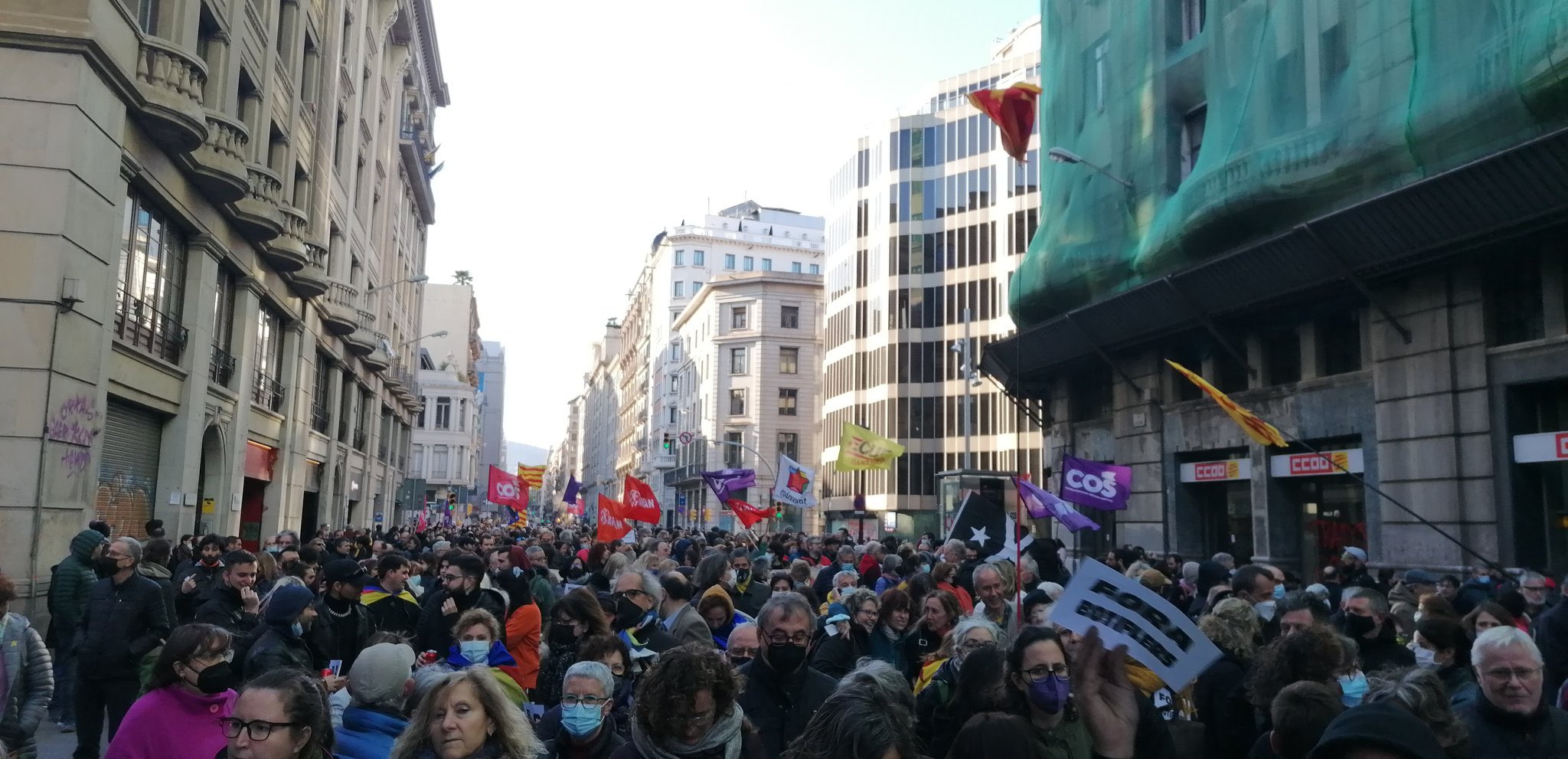
Thousands rally to live fully in Catalan language in Majorca, València and Barcelona


One hundred people have claimed this Saturday, April 2, in Palma, the "right to live in Catalan." All in the framework of the mobilization organized by 17 entities. This was explained by Carles Cabrera, the Secretary of Linguistic Normalization of the STEI Intersindical, one of the 17 entities that joined the mobilization. In statements to the media, he stated that "this Saturday's rally, organized by Enllaçats per la Llengua, in all Catalan-speaking territories, aims to claim the normality of this language in the Balearic Islands in order to live fully in Catalan."

In Barcelona a crowd of thousands people rallied against the political agreement to reform the Language Policy Act. This is the agreement signed by PSOE, ERC, JxCat and En Comú Podem, which states that Spanish "is used in the terms set by the language projects of each center" and from which JxCat ended up being demarcated. The protest began in Plaça de Sant Jaume and advanced through the center of the Catalan capital to the gates of Parliament, in the Ciutadella park. A police cordon guarding the building was waiting for them there.

First there was a rally, convened by the platform Enllaçats per la Llengua under the slogan ‘Enough’ and demanding to live fully in Catalan. After the reading of the manifesto, the demonstration convened by USTEC, COS, Intersindical, the Federated Associations of Families and Students of Catalonia (aFFaC) and the Student Union of the Catalan Countries (SEPC) . Trade unions (USTEC-STEs, Intersindical, CGT and COS), students (SEPC), families (aFFaC), with the support of organizations (ANC, Omnium) and platforms in defense of the language (CAL, Platform for the Language), have promoted the demonstration this Saturday afternoon in the center of Barcelona in defense of the Catalan school model and against the political agreement signed by ERC, Junts, PSC and Comuns which they consider puts an end to language immersion.

In València, the mobilization had the support of Decidim, ACPV, STEPV, Plataforma per la llengua, Juga en Valencià, COS and Escola Valenciana and was joined by more than a hundred people.


Read more »

2020/11/17

The Speaker of the Spanish Parliament removes the word to Galician and Catalan MPs speaking their languages

The president of the Spanish Parliament, Meritxell Batet (PSOE, Spanish Socialist), has removed the word today to CUP MP Albert Botran and the Galician BNG MP, Néstor Rego, to use the both Catalan and Galician respectively in defending their stance a non-law proposal that sought to urge the Spanish government to guarantee "the right to study exclusively in Spanish."

In the case of Botran, Batet has asked him four times to comply with the regulations and speak in Spanish, but the anti-capitalist deputy has refused. Arriving at the rostrum, the president of the chamber told him, "You must use the common language of this house and to which we owe it by regulation." Botran continued reporting in Catalan "Spanish linguistic nationalism" far right Vox and Batet removed the word to the deputy Free People party. Censorship and language supremacism of the Spanish majority against the minorities.

Read more »

2020/10/22

The Spanish Supreme Court prohibits Catalan among Catalan-speaking administrations

The Spanish Supreme Court prohibits Catalan among Catalan-speaking administrations in a ruling of 2020/10/21. The Spanish Inquisition Court has ratified the ban on the use of Catalan exclusively in communications between the Generalitat Valenciana and the administrations of Catalonia and the Balearic Islands. The high court has rejected the incidents of nullity presented in July by the Advocacy of the Generalitat Valenciana and a union against the sentence that the same court issued in June. Then the articles of the norm of linguistic uses of the Valencian Generalitat that regulate how the Valencian government must communicate institutionally with the autonomies of the same linguistic field, Catalonia and the Balearics. And it endorsed a previous sentence of the Superior Court of Valencian Justice, that considered that the Valencian government does not have competitions at the time of deciding in which language it communicates with the other communities. This is an exclusive competence of the State, enshrined in the law on common administrative procedure of public administrations (LPAC).

Read more »

2020/06/27

Political party denounces a pharmaceutical company for not labeling its products in Catalan too


The political party Força Catalunya has denounced the pharmaceutical company Almirall for not labeling its products in Catalan, as established by the law of the Consumer Code of Catalonia. "Discrimination of this nature is absolutely intolerable in any democratic system where the linguistic rights of its citizens must be guaranteed," the formation said in a statement.

The party insists that this pharmacy distributes products "intended for human consumption", and therefore "this lack of availability of consumer instructions in Catalan incurs a violation of the Consumer Code" which establishes as a priority to offer in Catalan those data mandatory directly related to the safeguarding of health and safety ".

It is for this reason that Força Catalunya demands that the Catalan Consumer Agency "proceed to open the corresponding sanctioning file, and impose the mandatory sanctions for the regulatory breaches expressed" in the complaint made by the party.

Read more »

2020/06/21

The Canigó's Flame Begins Its Way From Northern Catalonia (French State) to the Southern


The Flama del Canigó ritual is gradually becoming more popular and more established. It combines with the Sant Joan midsummer celebrations to evoke the common identity of Catalan-speaking lands.
The fire of the Flama del Canigó (Canigou Flame) is never extinguished. It keeps burning throughout the year at the Perpignan Castellet until 22 June, when it is carried to the mountain's summit. At midnight the fire from the flame is shared out among those present. Straightaway they set off, splitting and spreading the fire to light the Sant Joan bonfires in hundreds of towns, villages and cities.
On foot or horseback, by car, bike, boat and any possible means of transport, the Flama del Canigó reaches every corner of the land, thanks to the efforts of numerous groups and associations. Each village, town and city receives the flame in it own way, with music, devils, dance, etc., but always with a shared ritual. Everywhere, when the flame has reached its destination, before the bonfires are lit, a common message is read out to remind everyone of its significance.
This mobilisation requires a big effort to coordinate the routes the flame takes, complete all the paperwork and steps required to get the necessary authorisation and permits, and to publicise the movement so as to highlight and spread it. Obviously, all this work starts many months before Sant Joan, and some years ago now, Òmnium Cultural took on the central role as the body in charge of organising and promoting the activities hundreds of individuals, institutions and associations plan round the flame.
This ritual began in 1955, on the initiative of Francesc Pujades, who lived in Arles de Tec (Arles sur Tech). Inspired by "Canigó", the famous poem by Jacint Verdaguer, he got the idea of lighting fires at the top of the mountain for Sant Joan and spreading the flame around. The custom spread rapidly and in 1966 it crossed the border with France for the first time, reaching Vic. Despite Franco's dictatorship, the tradition gradually spread to all the Catalan-speaking lands, symbolising the survival of the country's culture.

Read more »

2020/06/05

The Spanish ruling party closes the Office of the Aragonese Language after four years of work

The Office of the Aragonese Language (Ofizina de Lengua Aragonesa) in Uesca has closed its doors for four years of work to "promote the normalization, use and presence of Aragonese in all areas of social and cultural life of the city ​​", as stated in the presentation of this area on the website of the City of Huesca. As planned, the service has stopped providing this May 30. The 2020 budgets had no item to extend the contract because “there are other priorities,” as justified in February by the socialist municipal government. The defense and promotion of the language was in front of the Spanish imperialist forces, PP and Citizens. The popular ones were especially critical with the positioning of the posters that welcomed in Huesca in Spanish and Aragonese in the entrances of the city. Now the Spanish ruling party PSOE has added to these positions.

In October 2019 from a PP motion that was seconded by Cs and Vox, the posters in Aragonese had already been removed. Without signs and without the Aragonese Language Office, of the attempt to promote a language that, according to the municipal website, "is part of our cultural heritage and our language history", only the posters of Ubierto and Zarrau (open and close) that several establishments remain commercials and hoteliers keep hanging on the doors.


Read more »