• Instagram Facebook Twitter YouTube e-Mail RSS

Denouncing the silent war
Spain is waging against Catalonia


2014/11/19

Spanish Army Chief about Catalonia: “when the metropolis is weak”, “the fall takes place”

The Chief of Spain’s Army Defence Staff, General Jaime Domínguez Buj, was asked asked on Tuesday about the situation in Catalonia and he has implicitly compared it with a colony. The main General of the Army stated that “when the metropolis is weak” is the time when “the fall takes place”. 

Jaime Domínguez Buj
He added that a “processes” such as Catalonia’s happens “when the central power is weak”, as happened in 1898, when Spain lost Cuba and the Philippines, he said. His words have caused quite some controversy. Later on, Domínguez Buj, nuanced his previous statement and said he was referring to 1808 and the Spanish War of Independence against Napoleon’s Empire. Such a war helped some of Spain’s American colonies to get their independence. He also added that he was referring to other historical periods and to other empires, such as those of the British, the Turkish and the Roman.

Nowadays, almost no one in Spain considers Catalonia to be a colony, neither most of the people supporting independence. However, on several occasions during the last few centuries, the Spanish Army attacked Catalan citizens and bombarded their cities and towns to stop them from quitting the kingdom, such as in the mid-17th century, when Catalonia was independent for a week, or in the early 18thcentury or early 19th century, when Catalonia also split from Spain for a few years. On top of this, in the mid-19th century, General Espartero – who was Regent of the Kingdom – stated that Barcelona should be bombarded every 50 years in order to remind Catalans about the Spanish rule. Furthermore, Francisco Franco talked about his “right of conquest” when he entered into Barcelona, at the end of the Civil War. He was using the expression written in the laws cancelling Catalonia’s self-government institutions and Constitution, which also banned the use of Catalan language, in 1716.

Back then, after Catalans lost the Spanish War of Succession, the new king Felipe V founded Spain as a Unitarian State and no longer a union of different kingdoms under the same crown. He tried to homogenise Spain under Castile’s rules and language, imposing a centralist government and a harsh political, social and cultural repression to Catalonia through the use of force, as he recognised when he wrote he was doing so “by the right of conquest”.

The Army is there to protect the Constitution, the Army Chief points out

Besides comparing Catalonia to colonial Cuba, Domínguez Buj, pointed out that the Army is “a tool” that the Spanish Government has with which to defend the Constitution. He said that armies “have to be ready to intervene in the way governments want”, being “inside” or “outside” the country. However, he also added that he does not think that Catalonia’s conflict will be solved “through the use of force”. He also said that the Spanish Government should “win the hearts of all Spaniards” and convince them of the advantages of being a Spanish citizen.

The General also added that he feels “pain for Spain” due to the situation of the last years, particularly because of the manifold corruption cases and Catalonia’s political process. Domínguez Buj was speaking in the Madrid-based Institute for International Affairs and External Policy.


Help Catalonia is an association that receives no subsidies whatsoever from the Spanish state, the Catalan government or indeed any other organisation. We, the people who work in this project, do so on a voluntary basis and for no financial gain whatsoever.
If you like the task we are performing and would like to help us carry on our undertaking you may make a donation through bank account No. IBAN ES69 0049 4751 4421 9506 0811 
Or you may also make a donation via PayPal clicking the button "Donate" . THANK YOU

Spanish Army Colonel Threatens Catalonia with Military Intervention

Spanish army colonel Francisco Alamán said in an interview to Alerta Digital that Catalonia would only be independent “over my dead body and that of many other soldiers,” arguing that the Spanish army has solemnly sworn to defend “the non-negotiable principle of Spain's unity,” and that they will defend it “even with our lives.” In the interview he made clear his extreme Spanish nationalistic views by emphasizing concepts like fatherland, Spanish nation, and Spain's unity as the sovereignty principles which the Spanish army has an obligation to address. He also said that "the armed forces are not here to serve the politicians, but the fatherland." He accused Catalan secessionists of being like "scavenging vultures," and made derogatory comments Read more....

Some in Spanish Army Encouraging Catalonia's Occupation


For a while, the media have been reporting about some people in the Spanish army in favor of a military intervention in Catalonia, as for example colonel Francisco Alamán's statements. Today recently retired lieutenant general Pedro Pitarch openly admitted that active and retired members of the military forces are working together in order to “encourage the armed forces” to occupy Catalonia.
In an interview published by El Confidencial, the lieutenant general, who has been in the reserve for three years but is still knowledgeable about the current situation in the army, states that “some military personnel are publicly urging to break ranks and go against the legal system” in order to take measures against Catalonia.
Former lieutenant general Pitarch regrets the fact that “nowadays the spirit of the coup d’état of February 23rd 1981 is back to haunt us,” and he adds that “the ill-meaning ideas that encouraged that coup are well alive.” Read more...

European Parliament vice-president proposes sending in military to prevent democratic referendum in Catalonia

European Parliament vice-president, Spanish nationalist Alejo Vidal Quadras, asked the Spanish prime minister, Mariano Rajoy, that he choose any brigadier general, “preferably from the guardia civil,” to put a stop to Catalonia's independence process. “Besides fighting the resolution in the courts, we must take over the autonomous region. The Spanish government needs to get in contact with Mas and tell him that what he's doing is against the law, and if he does not change his mind we'll be forced to step in,” he said.

He also offered some details about how this would work. “The Spanish senate meets, has a vote, then takes over the autonomous region. We disband their parliament, the Catalan government goes back home, and the Spanish government delegation in Catalonia takes over Catalonia. The brigadier general is to be in charge of the Catalan police.” Read more...

Spanish government pays homage to Hitler loyalists: once more, Spain is different

As already reported, the Spanish Government’s highest official in Catalonia recently paid homage to the “Blue Division”, a unit of the Wermacht. This did not lead to her firing or resignation, but instead Madrid has explicitly supported  Ms Maria de los Llanos de Luna. Many details have already been discussed in the press and the social media, but in order to understand how odd this is in the European context, we need to remember that the members of this unit made a personal, public, oath of allegiance to the Führer.
Thus, although this was Franco’s contribution to Hitler’s war in the East, together with economic cooperation and intelligence support, each soldier of the Wermacht’s 250th division personally made an oath of loyalty to the German dictator. Therefore, we are not talking about a purely Spanish unit that may have taken part in the hostilities, but rather about a division fully integrated into the German Army. A look at their uniforms, for example, read more...

Unfair Play Against Catalonia

The retired Spanish army officer Francisco Alamán reiterated and elaborated his threats against Catalans in a new interview to Alerta Digital. This time he went even further and demanded that the Catalan MPs who have placed charges against him (Joan Tardà, Alfred Bosch, and Uriel Bertran) be detained “for wanting to fracture Spain and for high treason.” He also demanded that “all political parties that have as their main goal the fracturing of the [Spanish] nation be made immediately illegal.” Alamán claims to have received many messages of support after his first interview, and he declares himself openly a Franco admirer. When they ask him “Do you admire Franco?” he answers “Which Spaniard could not admire him? [...] Read more...


Spanish army chief makes dark comments about Catalonia secession bid


Spain's army chief has waded into the growing storm over Catalonia's secession bid from Madrid. Chief of the General Staff Jaime Domínguez Buj likened the current state of affairs in the country to Spain's losses more than a century ago during the Spanish-American War.
"When the metropolis is weak," Dominguez said, "the collapse happens."
By metropolis, he is using a term popular among academics for the center of political and colonial power in an empire. When the conflict with the U.S. ended in 1898, Spain had lost its hold over Cuba, the Philippines, and Guam,...read more...

Spanish Retired Military Officer Demands that President Mas Should Be Sent to Prison

After all the first controversial statements by retired Spanish army officer Alamán, no one has silenced him. Quite the opposite. The complicit silence of the Spanish government has given him more strength and he has asked this time that Catalan President Artur Mas be sent to prison, and also all Catalan police people who would not act to jail him. Yesterday a tribunal decided that the Colonel statements threating Catalonia were not only absolutely legal but "freedom of speech".
The retired colonel is not satisfied with sending elected President Mas to jail, he also wants the Catalan police to act againt Catalan government representatives. Again Mr. Alaman keeps his threats to Catalans and Catalan institutions. He asked “When ******* Mr. Mas seriously violates the Spanish Constitution, he needs not to be convinced, but he should be sent to jail, and if we are in a rush for this, a couple of civil guards will do, who are always willing.” Read more...


Related articles:


Read more »

2014/10/16

Catalonia’s main employers’ associations criticise the Spanish Government’s 2015 budget: the lowest in 17 years


Pimec’s President, Josep González
Far below what is required for current infrastructure developments

Catalonia’s main employers’ associations, Pimec and Foment, have expressed their outrage at the new budget figures proposed by the Spanish Government for 2015 and its planned investment in Catalonia. The €1,072.26 million of territorial investment allocated to Catalonia represents 9.5% of Spain’s total budget, while the percentage is half the weight of Catalonia within Spain’s GDP (19%) and is very far from what it represents in population terms (16%). From a purely economic point of view, this has been seen by the employers’ associations as “a missed opportunity” to invest in Spain’s most productive area, which is currently leading the economic recovery. The proposed investment for Catalonia, the lowest in 17 years, is far below what is required for current infrastructure developments, despite the economic crisis.

According to Foment, Catalonia’s main employers’ association that groups its largest companies, investment is sorely needed for “essential” projects such as improved railway access to the Port of Barcelona, an area with enormous potential for international investment, and to complete the priority road networks, investment for which Catalonia has been “waiting for years”. This inadequate budget has been viewed as “a missed opportunity”, both for economic development in an area leading Spain’s economic recovery, and a lost chance for dialogue between Catalonia and Spain, at a time of high political tension between the two due to the independence debate.


Employers’ associations outraged at Spanish Government’s 2015 investment in Catalonia

Catalonia’s main employers’ associations, Foment and Pimec, have expressed their outrage over the 2015 budget proposal for Catalonia, announced by the Spanish Government last week. Foment represents Catalonia’s biggest companies and Pimec its small and medium-sized enterprises. Both organisations have expressed a “total rejection” of the Spanish Government’s draft budget for 2015, announced by the Spanish Finance Minister Cristóbal Montoro, as figures reveal that investment in Catalonia will drop to 9.5% of Spain’s total. The figure represents the “lowest percentage since 1998″ and “far from the maximum of the last 20 years,” which was 15.9% in 2003. However, all those percentages are far from what Catalonia represents in terms of GDP and population, respectively being 19% and 16% of Spain’s total.

“Total rejection” of a budget “inadequate” for the improvement of economy

Both employers have expressed their “total rejection” of the new budget, as it falls far short of the investment sorely needed to complete current projects in Catalonia, and harness its economic potential. Not only has the figure, the lowest investment from the Spanish Government in the last 17 years, in relative terms, been criticised for coming at a time of tension between Catalonia and Spain, it is also far from supporting the economic recovery. Catalonia is currently leading Spain’s recovery, through its industry, export and tourism sectors, which need high level infrastructure.

These low figures are the latest in decades of infra-budgeting for Catalan infrastructure. So evident has this been, in 2005 the Spanish Parliament approved a law to allocate to Catalonia at least the equivalent of its weight with Spain’s GDP (equivalent to 19%) between 2007 and 2013 as a way to compensate for this lack of investment. However, it was never respected during those 7 years, even though the legal obligation was expressed in percentage terms (19% of Spain’s total territorial investment) and not in absolute terms (with a specific amount of money). On top of this. last year (the last one when it should have reached at least 19%, according to the current legislation) the investment was particularly low (9.6%). Incidentally, this was the first budget prepared after a majority of the Catalan society put forward its independence demands in September 2012.

“Catalonia clearly discriminated against once again”

According to Josep González, who is President of Pimec, the new Spanish Government’s budget is a sign that “Catalonia is clearly discriminated against once again”. According to him, the Spanish Government “keeps focusing on unproductive infrastructure such as the AVE high speed train [to rural areas], with a low return on investment and that are not aligned with a policy of deficit reduction,” he pointed out. Similarly, employers led by Josep Gonzalez lamented that the new budget does not contemplate measures to improve competitiveness in the small and medium enterprises, such as the reduction of social security contributions or the reduction of energy costs. According to Pimec, the budget presents “overly optimistic macroeconomic assumptions.”

The Catalan association of SMEs found that the gap between estimates of revenue and expenditure meant that the bulk of the increase would have to come from higher income tax and VAT, “in circumstances that mean they will not be easy to get”. Moreover, Pimec accounts are still showing alarming alerts, of a public debt that is already “too high”.

“The deficit continues to be asymmetrically and arbitrarily distributed between the State [Spanish Government level] and the Autonomous Communities [such as Catalonia], benefiting only the State,” warned the Catalan employers, who there are “significant gaps” in spending in areas such as energy.

A “missed opportunity” for dialogue between Catalonia and Spain

The Spanish Government’s budget proposal for 2015 comes at a time of high political tension between Spain and Catalonia, with the latter’s independence movement gaining increasing popularity. There are also a significant number of voters who would prefer increased autonomy over breaking away. Many have seen the new budget, the lowest 17 years allocated to Catalonia, as a missed opportunity for fostering economic recovery and political dialogue. In refusing the former, the Spanish Government may have lost the opportunity for the latter.

The employers’ associations regret that the planned budget of 2015 for Catalonia does not promote “dialogue, negotiation and agreement” with Catalonia. Ramon Adell, the Director of the Foment’s Commission for the Economy and Taxation, regretted that the investment budget to Catalonia posts a figure that “is insufficient: from the economic point of view, it deepens the divide between Catalonia and its development, seen many time”. During a press conference held on Tuesday, Adell said that Catalonia, “as the engine of recovery, deserves a greater investment in infrastructure.”

Adell lamented that “long periods of instability are bad for the economy” and recalled that Joaquim Gay Montellà, the President of Foment, repeatedly defended “dialogue, negotiation and consensus” as being the way to reach an agreement between the Catalan and Spanish Governments. However, the Spanish Executive’s budget for 2015 does not seem to proceed in this way.


Read more »

2014/06/07

The soon-to-be King Philip VI defines:"Spain is ONE(!!!) nation ONE(!!!) united social and political COMMUNITY deeply rooted in a ONE-THOUSAND-year old (!!!) history"


The soon-to-be (of course, non-elected) Spanish King Philip VI defines Spain in his first public speech after his father's abdication:

"Spain is ONE (!!!) nation… ONE (!!!) united social and political COMMUNITY deeply rooted in a ONE-THOUSAND-year old (!!!) history.”
Wishful thinking, I’d say.
And after stating that Spain is this ONE NATION he glibly adds:
“…and diverse”.

His vision of Spain clearly doesn’t sincerely contemplate the actual DIVERSITY of NATIONS within –currently ruled under ONE state and an oligarchy that still insists on denying their existence.

Does anyone still think the Spanish state and Establishment appreciate, serve and give the due respect to the several nations within the Iberian Peninsula they rule?
Does anyone still wonder why THE NATION OF CATALONIA is seeking to have its own state?

Francesc Xavier Canals

Read more »

2014/01/26

Secession: Catalonia And The “Bad Precedent” Argument

Seeing how successful my first post on this topic was, I’m unable to resist the temptation to write a follow-up – so here we go.
For those of you too lazy to read my first post, here’s a recap: Spain is introducing fascist laws to strike down against a region known as Catalonia (mostly known for its capitol, Barcelona) which seeks independence from the rest of Spain. Catalonia is an economically strong (relative to the rest of Spain) region and the Catalans are tired of subsidizing the rest of the country while their culture is being oppressed. Spain has reponded the only way fascists know how to respond: By essentially outlawing demonstrations. Of course, trying to stop people from wanting to secede by banning them from expressing their desire to do so is about as intelligent as trying to stop a flood by legislating against rain. Alas, this is what you would expect from a government that consists of a party with fascist DNA (it was founded by Franco loyalists).
Today, I would like to deal with one of the most popular arguments against Catalonian independence: That it will set a bad precedent. This argument showed up in the comment section after my last post – it goes something like this: If Catalonia can become independent, then what is there to stop Flanders, Scotland, the Basque country, Cornwall and Bavaria from breaking away – just to mention a few of the regions in Europe where separatism exists? What is there to stop Europe from breaking up into thousands of small pieces?
There are several things that can be said in response to this argument. Below, I am going to outline both why the argument is unreasonable on its own, and also why Catalonia really is a special case.
First of all, it needs to be said that there are few separatist movements in Europe which are supported by a majority. While they exist in a lot of places, substantial levels of popular support for independence is rare. The reason is quite simple: Usually, separatism is not the best course of action. Hence, the idea that Europe would break up into hundreds of tiny states if Catalonia were to achieve independence is absurd – even if we allowed every region in Europe in which separatists have majority support to become independent, the number of new states would almost certainly be less than 10 (and very likely less than 5).
Secondly, Catalonia has desired independence for a long time. In the United States, you will occasionally hear people speak of secession when they are really angry with something the federal goverment has done. Texas Governor Rick Perry made some badly-concealed threats of secession back in 2009 – reminding everyone that Texas has a right to secede if it so wishes (most scholars on the subject disagree, but that’s a separate issue). The underlying reason why he threatened secession was Obamacare. I would argue that if Texas had declared independence in 2009, that would have been unjustified – there is no deep cultural divide between Texas and the rest of the country, Texan culture is not oppressed in any way, and Texans have not desired independence for very long – there was a sudden temporary uptick in support for secession when Obama proposed his health care reform, but otherwise Texans (like all other Americans) have been quite happy being in a union with the other 49 states. In Catalonia, independence has been desired for a long time – yes, support has hardened in recent years with the disastrous economic policies of Madrid and the ever-increasing oppression of Catalan culture (I’ll get to that in a minute), but it’s not exactly a new phenomenon; Catalan separatism goes back to the 19th century and became really popular under Franco – no part of Spain suffered as much as Catalonia under Franco, who did everything he could to kill the Catalan culture (fascism emphasizes conformity as we all know, so catalan culture – which stood out considerably from the rest of Spain – had to be destroyed).
This is one requirement that I would have personally in order to support an independence movement: That separatism isn’t merely a political fad, something that is trendy now but will soon be forgotten. Catalan separatism is certainly here to stay, no-one can reasonably argue otherwise. That’s the reason Spain is implementing the measures that I described in the previous post; they know that they can’t just wait for the separatist movement to falter and die on its own – that’s just not going to happen.
Another thing that is important to understand is that Catalonia really does face cultural oppression. The Spanish minister of education has made it his official policy to “hispanicize” Catalonia and forbid Catalan children from learning the Catalan lanugage as well as the region’s history. While there are severe penalties for anyone who dares to burn a Spanish flag, the Catalan flag has been burned live on Spanish TV.
Worse, Catalonia has suffered economically from a boycott, from no other than Spain: That’s right – the Spanish are boycotting one of their own regions. As if overtaxing them wasn’t enough, and by that I mean taking 9 bn euro more in taxes from Catalonia than Catalonia gets back (this kind of unfair regional distribution of taxes is unseen; Catalonia is literally the most overtaxed region in the entire world). Note: This represents about 9 % of Catalonia’s GDP.
And then, in the midst of oppressing their culture, stealing their hard-earned money and boycotting their products, the Spanish are surprised when the Catalans decide they’ve had enough and demand independence. And then, they argue that this would establish a “bad precedent”.
Let me offer the following counterpoint: Yes, separatism may establish a bad precedent. However, here is what needs to be considered: A precedent will be set either way. There is no neutrality in this issue; either you are with the free people of Catalonia, or you are with the fascists in Spain.
If Catalonia were to fail to gain independence, what precedent would that set? It would set a precedent stating that a country can treat a subset of its people as if they are second class citizens, and get away with it. It would be a victory for fascism, racism and totalitarianism. Is that really preferable?
Also tragically, it would establish a precedent that peaceful means are useless if you want independence. Catalan separatists have never resorted to terrorism (and according to the people I know within the movement, they never will). They are not like the certain (not all of them of course) separatists i Chechnya or the Basque country – they’ve always played it fair. While other separatists fight with bombs, the Catalan separatists form a human chain consisting of 1.6 million people (pretty impressive considering Catalonia’s population is only 7.5 million).
The Spanish authorities on the other hand are not so peaceful; they have regularly threatened to use their military might to crush any attempt from Catalonia to secede.
When you ask yourself whom you support in this conflict, what you really should ask yourself is this: Who are the bad guys? Are the bad guys the ones who are overtaxing, boycotting and cultually oppressing, or are the bad guys the ones who are victims to all these acts? Are the bad guys the ones who are threatening military force, or are the bad guys the ones who have never used it and never will?
I think we all know the answer to that question. And that is why I am siding with the Catalans and their right to choose their own destiny. I hope you will join me.
Please visit http://www.helpcatalonia.cat for more information and news on the Catalan struggle for independence.

John Gustavsson

Read more »

Mysterious destructions of ancient Tibetan heritage sites

Several fires have broken out on the last weeks throughout the whole Tibetan territory, devastating some of the most important buildings and heritage centres in Tibet. The last one took place on 11 January in Gyalthang town, situated in Kham region in Southern Tibet (Ch.: Dukezong, Shangri-La County, Deqen Prefecture, Yunnan province). It gutted the historical centre of the city and destroyed nearly 300 houses, mainly made of wood. However, the conflagration made no casualties although 2,600 people were displaced or left homeless, and it took Chinese firefighters more than 10 hours to extinguish the flames.


Gyalthang is situated in Shangri-La county, the name of which was changed by the Chinese Communist Party from Zhongdian, which was given to it when the Chinese army occupied Tibet in the 1950s. It was renamed by Chinese authorities in 2001, in order to turn the county into a touristic area as it shares the name with the fictional land James Hilton wrote about on his novel Lost Horizon, written in 1933. Nevertheless, the renaming drew criticism by Tibetan writer and activist Tsering Woeser as well as several Tibetan and non-Tibetan advocacy groups. For instance, the American newspaper Global Post wrote a series of articles criticizing the move by the Chinese Government as an attempt to transform the area in a sort of Tibetan Disneyland regardless of the people who are living there. In fact, the area has seen an increase flooding of Han migrants who are building plenty of tourist establishments in the city centre, just at the place where most local Tibetan population live. Furthermore, the authorities are encouraging the move of people from all around China in an attempt to "economically develop" the county and "improve the living standards of the local population. On the other side, Tibetans are often underemployed due to the flooding of Chinese skilled workers who get the best paid jobs, so the local population is facing an increasing poverty and marginalization. Moreover, some tourists who had been there complaint about the fact that many of the traditional buildings in Gyalthang (or Dukezong, in Chinese) have been demolished and replaced with brand-new ones which pretend to respect the traditional architecture.
In addition, the circumstances of the fire still remain unclear. The official China Daily newspaper blamed it on an electrical fault that took place inside an inn on the town centre, quoting local authorities. However, it seems quite implausible that a curtain on fire could damage nearly 300 houses and other symbols of ancient Tibetan heritage like thangka and culture relics in spite of the obstacles that firemen could face while putting an end to flames. Moreover, it seems that a fire prevention system which costed approximatelly a million dollars failed due to the freezing cold that disabled the pipes and the fire engines were unable to get close to the fire in the narrow streets of the town. Furthermore, local authorities have triggered the population's criticism because of the way in which they are facing the consequences of such catastrophe. In fact, most of the people who were left homeless, mostly Tibetans and Naxi, have stated that they were left outside with no clothes or bedding after having lost everything despite the freezing cold and two heavy snowfalls that had taken place on the days after the fire. Nevertheless, authorities have stated that they were sending emergency kits to the area and they had accommodated the victims at several hotels.
Leaving the possible causes aside, it seems hard to believe that it had been an accident considering that it had been the second burning incident in less than a week. On 9 January, another blaze destroyed about 100 houses belonging to Larung Gar Buddhist Academy in Serthar, a town also situated in Kham region (Ch: Seda County, Ganzi Tibetan Autonomous Prefecture, Sichuan Province). Ironically, one of the possible causes of the fire was an electric fault, as in the fire that destroyed nearly two thirds of Gyalthang city only three days later. However, other sources state that it might have been caused by a butter lamp at one of the nuns' rooms.
As the picture below shows, the flames turned the buddhist academy in something like a hell on earth. In fact, some witnesses stated that the flames could be seen from all around the area and had lit up the night. According to official Chinese sources, as many as 450 firemen, policemen and rescuers tried to put out the fire during hours but could not prevent some of the nuns' residences from burning. Nevertheless, it luckily did not cause any casualties or damages to the ancient heritage of the monastery although it left about 100 nuns homeless so far.


As if this was not enough, these two blazes have not been the single ones taking place in Tibet in the last year. Eventually, another one hit Ganden Thubchen Choekhorling monastery in Lithang county of Kham region (Ch: Litang County, Ganzi Tibetan Autonomous Prefecture, Sichuan Province) on 16 November 2013, destroying the main prayer hall built in the 16th Century. In fact, the monastery was built by Sonam Gyatso, the third Dalai Lama, in 1580 and was one of the few ancient Tibetan monasteries which survived to the Cultural Revolution that shook Tibet and China between 1966 and 1976. It did not cause any casualties and its effects were limited to the multi-story main prayer hall withouth affecting any buildings of the monastic complex. Furthermore, the fire which destroyed Lithang monastery was also due to an electric fault originated in one of the visitors' halls of the religious building and erupted at night as well. In addition, it was also difficult to put out the flames as nearly 2,500 people were needed to extinguish them, whereas several monks had to be rescued from the raging inferno the prayer hall had become in. However, it seems that some of the most sacred objects inside the room could be saved. 
In conclusion, it seems unbelievable that three different fires could erupt in less than a year at the same region and in the same way, charring some of the most important Tibetan heritage sites across Kham. Furthermore, they are more unlikely to be accidental considering that Chinese authorities are developing plans to turn some of the most important Tibetan cities into touristic attractions despite the damages those policies could inflict to the local population. The most highlighted case is the series of reforms that the CCP is implementing in Lhasa, where authorities are building a shopping area with underground parking facilities right in the Barkhor, the sacred circumvalation road aroud the Jokhang temple which is the main way for Buddhist pilgrims into the city. Furthermore, most of the local Tibetans living in the area have been forced to move into newly built suburbs outside the city centre. So it seems that the Chinese Communist Party is really committed to destroy ancient Tibetan symbols just for tourism and propaganda purposes.
Help Catalonia

Read more »

2013/11/20

Spanish School Play On Invading Gibraltar


On Friday 27th September 2013, a Youtube video of horrendous proportions was removed by its owner due to international condemnation placed on the events of that footage. It involved Spanish youths acting out a school play on the invasion of Gibraltar and opening fire on British/Gibraltarian citizens.

Though the Spanish actions and sentiments behind this video do not surprise Gibraltarians, it certainly shocked many Youtube viewers globally who expressed their disgust at the thought of an educational institution inciting violence towards a people through their youth. What is even less surprising to Gibraltarians is that not a single organiser of the school play or teacher seems to have been prosecuted by the state for expressing what could very well be hate crimes under international law. 

Since the upload and removal of the video from Youtube, there has been no sign of the event being reported as a headline in Spanish papers or television. It has however been reported by Gibraltarian and various British papers and also Catalunya’s LaVanguardia. 

It is worth noting that the right-wing trade union in Spain known as ‘Manos Limpias’ took legal action against TV3 of Catalunya several days before the video was uploaded. The action was due to a documentary which interviewed children who participated in the recent human chain during Catalunya’s national day this past September 11th. Manos Limpias claimed that the exposure of these children who expressed their desire for an independent Catalunya have violated laws on the protection of minors and international conventions on the rights of those children. No similar legal action was taken against the school play.

In Gibraltar’s view, the sad reality appears to be that it is in the interests of the Spanish state to continue indoctrinating the country’s next generation towards reclaiming sovereignty over the British Overseas Territory through any means necessary. Bullying tactics against Gibraltar continue and it is unclear whether Spain’s next generation of politicians will change their stance and promote more diplomatic approaches in the future.

Jared Baglietto

Read more »

2013/02/12

Bullfights whether-you-like-them-or-not

Please forgive me speaking about myself, but I've spoken out against the banning of bullfights for political, ideological, ecological, commercial and festibe reasons, and I went to the last, wonderful bullfight by José Tomás at the Monumental bullring (in Barcelona). However, as a democrat, I understood that the decision of the majority had to be accepted. This week it is expected that the go-ahead will be given in the Congress of Deputies to a popular legislative initiative that proposes that bullfights be classified as an activity of cultural interest, with the aim of overruling the Catalan and of imposing once more, whether-you-like-them-or-not, the holding of bullfights in Catalonia. The affair acquires a far from folkloric political dimension because it throws into doubt the very existence of politics and of democracy in Catalonia and even the usefulness of its institutions of self-government.
It just so happens that the PLI that led to the ban arose from a petition signed by people in Catalonia, while the PLI to overrule it was promoted by signatures of citizens the vast majority of whom do not live in Catalonia. That is, those who don't live in Catalonia are able to impose their criterion those that do live in Catalonia in matters that only affect the latter and not the former. To put it another way, it doesn't matter how the Catalans want to live, because they have to organize their coexistence as the majority of the rest of Spaniards, that don't even live in Catalonia, choose.
The bullfighting issue could be regarded as an anecdote were it not part of a systematic trend. The Parliament of Catalonia adopted a declaration on sovereignty and the Spanish Government has announced it will ask the Constitutional Court to annul it. The Parliament decided by a vast majority how to organize its linguistic coexistence in education in accordance with the political and social majorities in Catalonia, but the Spanish Government and courts decided that it is the coexistence criterion that the political and social majorities in the rest of Spain want not for themselves but for Catalonia that has to be applied. Since the ruling of the 2006 Statute of Autonomy, any initiative of any importance that is adopted by Catalonia's democratic institutions is likely to be on the road to annulment. Right now the Spanish Government has challenged and frozen laws, decrees or other norms adopted in Catalonia that affect taxes, the financial system, the health systema, the education system and the organization of commerce...
The Spanish Government and the main parties keep calling repeatedly for the "train collision" between Catalonia and Spain to be avoided, but it is always in exchange for Catalonia giving up politics, without bearing in mind that when people realize that the Catalan Parliament is of no use for channeling the will of the citizens, what is most likely, according to the laws of physics, is that that will will eventually overflow.

Read more »

2012/10/12

Unionist groups demonstrate in Barcelona against Catalonia's independence

October 12th is the day Spain celebrates the “Day of Spain” (Dia de la Hispanidad).This day has been chosen by Pro-Spanish groups to demonstrate in favour of Catalonia’s ongoing submittance to Spain. It is a die-hard attempt to respond to the million-and-a-half-strong Demonstration of last 11th September, the National Day of Catalonia, a demonstration that hit the headlines of the press worldwide.
Today’s demonstration has been attended by a motley crew of minority political parties and two parliamentary groups (Partido Popular and C’anos), all of whom are opposed to Catalonia’s right to self-determination that they see as illegal. The attendance has been extremely low, about 6,000 people basically coming from Spain in buses.

Read more »

2012/10/07

Video (sub English): An Extremadura-Born Catalan Says, "I love Catalonia, I'm not Going Back"

Isabel Buján, an Extremadura-born woman, recently posted a video on Youtube were she calls them as she sees them. She released the video in response to Extremadura's former president, Guillermo Fernández Vara, who proposed a mass deportation. Vara's big idea was to deport 150,000 Catalans of Extremaduran descent back to Extremadura. Such idea comes from a leading member of an, in theory, leftist and progressive plitical party—PSOE. Here is Isabel Buján's video, with subtitles in English. Below you can find the English translation.

 
I'm from Extremadura, from Jerte del Valle.
We are nine siblings in total. All of us siblings came to Catalunya for good, except for one that moved to Bilbao instead.
We're all integrated in Catalunya, they have loved us immensely.
We have worked hard, but they have been kind to us.
If you think that we are going back to our homeland, you give us a home.
I have children, grandchildren and soon, I'm going to have great-grandchildren.
You just can't force me to go back to Extremadura because I don't feel like it,  and I will simply refuse. I won't go.
And if you want people to go back to Extremadura, you'll have to provide them with work and a decent house, and then we'll find out how many people from Extremadura are willing to go back.
I don´t think too many will, because Catalonia has treated us very well.
We speak Catalan and we feel this is our home ​​and if you do not like it, piss off!

Read more »

2011/06/16

The Violation of the Human Right of Self-Determination in Spain

The right of self-determination is a human right, basis of the United Nations and its purposes and a key concept in the most important international Covenants and Charters. It is also an ius cogens norm, the highest category in international law.

Take for example the International Covenant on Civil and Political Rights (United Nations, 1966), Part I, Article 1:
  1. All peoples have the right of self-determination. By virtue of that right they freely determine their political status and freely pursue their economic, social and cultural development.
  2. All peoples may, for their own ends, freely dispose of their natural wealth and resources without prejudice to any obligations arising out of international economic co-operation, based upon the principle of mutual benefit, and international law. In no case may a people be deprived of its own means of subsistence.
  3. The States Parties to the present Covenant, including those having responsibility for the administration of Non-Self-Governing and Trust Territories, shall promote the realization of the right of self-determination, and shall respect that right, in conformity with the provisions of the Charter of the United Nations.
Articles in this covenant are considered colective human rights, although some are not directly included in the Human Rights Declaration. To quote a recent statement (May 2011) by the Human Rights Council of the General Assembly of the United Nations: "[...]the existing international human rights standards [...] of the International Covenant on Civil and Political Rights [...]".

The right of self-determination is also enshrined in the first article of the International Covenant on Economic, Social and Cultural Rights (United Nations, 1966) with the same exact words.

Another relevant example is the first article of the Charter of the United Nations, which states that one of the four purposes of the United Nations is "to develop friendly relations among nations based on respect for the principle of equal rights and self-determination of peoples, and to take other appropriate measures to strengthen universal peace".

Although the Kingdom of Spain is part of these Covenants, it doesn't recognize the right of self-determination of Catalonia, the Basque Country or anyone else, for that matter. Not only it refuses to recognize the independence of Kosovo, it is the only state in the European Union that states in its Constitution [pdf] that its army has the mission to protect "the indissoluble unity of the Spanish Nation, the common and indivisible homeland" of all its citizens. Although the Spanish Constitution grants some self-government to the different regions in the kingdom, the text, as well as successive decrees by the Constitutional Court, makes it very clear that this self-government exists only because it's granted by Spain and depends on the volition of the Spanish Kingdom, and not in the democratic decisions of the peoples and Parliaments, ignoring that the Generalitat (the institution of Catalan government) was officially restored before the Constitution was approved. In fact this institution was founded between the XIII and XIV centuries and its current President is officially the 129th President of the Generalitat of Catalonia.

Former President of the Basque Country.
Photo: VINCENT WEST / REUTERS
Take the recent case of the Basque Country, for example. Its Parliament approved in 2004 a new political statute for the country based on its free association with Spain on equal footing that included the right of self-determination, in a way similar to Puerto Rico within the United States. This democratic decision was refused by the Spanish Parliament.

After this, in 2008, the Basque Parliament approved to call a nonbinding referendum (because a binding referendum in Spain can only be called by the Spanish Government) about the exercise of self-government by the Basque Country. The Spanish authorities suspended the referendum plans and ruled that the referendum was against the law and the Constitution. A new law was then created to suspend any kind of self-government and imprison the members of any regional government that dared to call any nonbinding referendum without the explicit approval of the Spanish Government.

The Parliament of Catalonia
The Catalans didn't go that far. In 2006 the Catalan Parliament approved a new Statute of Autonomy with the support of 90% of its deputies. The Spanish Parliament substantially modified the new Statute in matters such as economy, justice and recognition of Catalonia as a nation within the Spanish State. Nevertheless, most Catalan political parties still promoted the affirmative vote in the referendum held that year because the new statute was still better than the previous one.

After its approval in the binding referendum, different Spanish regions and political parties took the Statute to the Constitutional Court and, after four years of deliberations, in July 2010 a sentence from this Court removed or modified 41 articles of the new Catalan Statute, including the definition of Catalonia as a nation, the protection of Catalan self-government, language and culture, a fair funding system and a new judicial system for Catalonia, rendering the new Statute even worse than the previous one in many fundamental aspects.
On April 10th 2010, 1.5 million Catalans shouted
"Independence" and "We are a nation, we decide".
Check an aerial video of the march an
hour before it started.
A massive demonstration of 1.5 million people was held in Barcelona on July 10th -just the day before the Football World Cup that Spain won- against the ruling, with its main slogans being "We are a nation, we decide" and "Independence". It was one of the largest demonstrations in the modern history of Europe and is particularly remarkable in a country of 7 milion people. Furthermore, it had the support of thousands of cultural, political and civil organizations, personalities and individuals. Nevertheless, Spain didn't change its mind, and some Spanish TV networks didn't even mention the event, saying that in Catalonia people spent the day at the beach and excited for the possibility of Spain winning the World Cup.

The Catalan President Lluís Companys and the
Catalan government in prison after declaring the
independence of Catalonia in 1932.
After that, on March, 10th, 2011, the Catalan Parliament proclaimed that it is the "Seat of the Sovereignty of the Catalan people" and that the "right of self-determination of all the peoples" is "an inalienable right of the Catalan people", similar to what had already proclaimed in 1989 and 1998 after Franco's nationalist and fascist dictatorship. Of course similar statements had been made even before, including declarations of independence stopped by the Spanish army.

Regardless of the right of self-determination, when Spain negates the right of the Catalans to define themselves as a nation, it is also against a 2006 recommendation of the European Council:
The Assembly believes it necessary to strengthen recognition of every European citizen’s links with his identity, culture, traditions and history, to allow any individual to define himself as a member of a cultural “nation” irrespective of his country of citizenship or the civic nation to which he belongs as a citizen, and, more specifically, to satisfy the growing aspirations of minorities which have a heightened sense of belonging to a certain cultural nation. What is important, from both a political and a legal standpoint, is to encourage a more tolerant approach to the issue of relations between the state and national minorities, culminating in genuine acceptance of the right of all individuals to belong to the nation which they feel they belong to, whether in terms of citizenship or in terms of language, culture and traditions.
The same recommendation acknowledges that the concept of "nation" differs in the different nations, but that being the reason of the disagreement between Catalonia and Spain would only prove that they are separate nations.

Languages in Europe
How can Spain possibly justify these actions that clearly violate the right of the Catalan and Basque peoples to "freely determine their political status and freely pursue their economic, social and cultural development" as stated in the International Covenant on Civil and Political Rights? How is the resulting economic despoiling of 10%+ of Catalan GDP to "freely dispose of [...the...] natural wealth and resources" for "their own ends"? In fact, many well recognized economists have stated [1][2] that Catalonia would be “one of the richest countries in the world” if it were independent.
Is Spain really promoting the "realization of the right of self-determination"?

The Kingdom of Spain alleges that self-determination only applies to colonies and that any other declaration of independence would violate the international principle of territorial integrity. We'll let the International Court of Justice explain:
The International Court of Justice
Several participants in the proceedings before the Court have contended that a prohibition of unilateral declarations of independence is implicit in the principle of territorial integrity. [...] The Court recalls that the principle of territorial integrity is an important part of the international legal order and is enshrined in the Charter of the United Nations, in particular in Article 2, paragraph 4, which provides that:
“All Members shall refrain in their international relations from the threat or use of force against the territorial integrity or political independence of any State, or in any other manner inconsistent with the Purposes of the United Nations”.

After quoting previous cases in the international law, the Court concludes that "the scope of the principle of territorial integrity is confined to the sphere of relations between States" and "considers that general international law contains no applicable prohibition of declarations of independence". This means that the principle of territorial integrity only implies that existing states cannot attack each other to take over their territories, but in any case can be taken as a implicit prohibition to the realization of the right of self-determination, including all types of declarations of independence.
Note that although this sentence comes from the ruling regarding the unilateral declaration of independence of Kosovo -which "did not violate general international law"- the Court clearly made the point according to the general international law, and not to the specific case.

Furthermore -as the Court also notes- many other countries have achieved independence in the XX century in Europe. To name just a few from the second half of the century until now:
  • 1960 Cyprus
  • 1964 Malta
  • 1991 Ukraine
  • 1991 Croatia
  • 1991 Georgia
  • 1991 Armenia
  • 1991 Moldavia
  • 1991 Belarus
  • 1991 Kazakhstan
  • 1991 Macedonia
  • 1991 Azerbaijan
  • 1992 Bosnia and Herzegovina
  • 1993 Czech Republic
  • 1993 Eslovaquia
  • 2006 Serbia
  • 2008 Kosovo

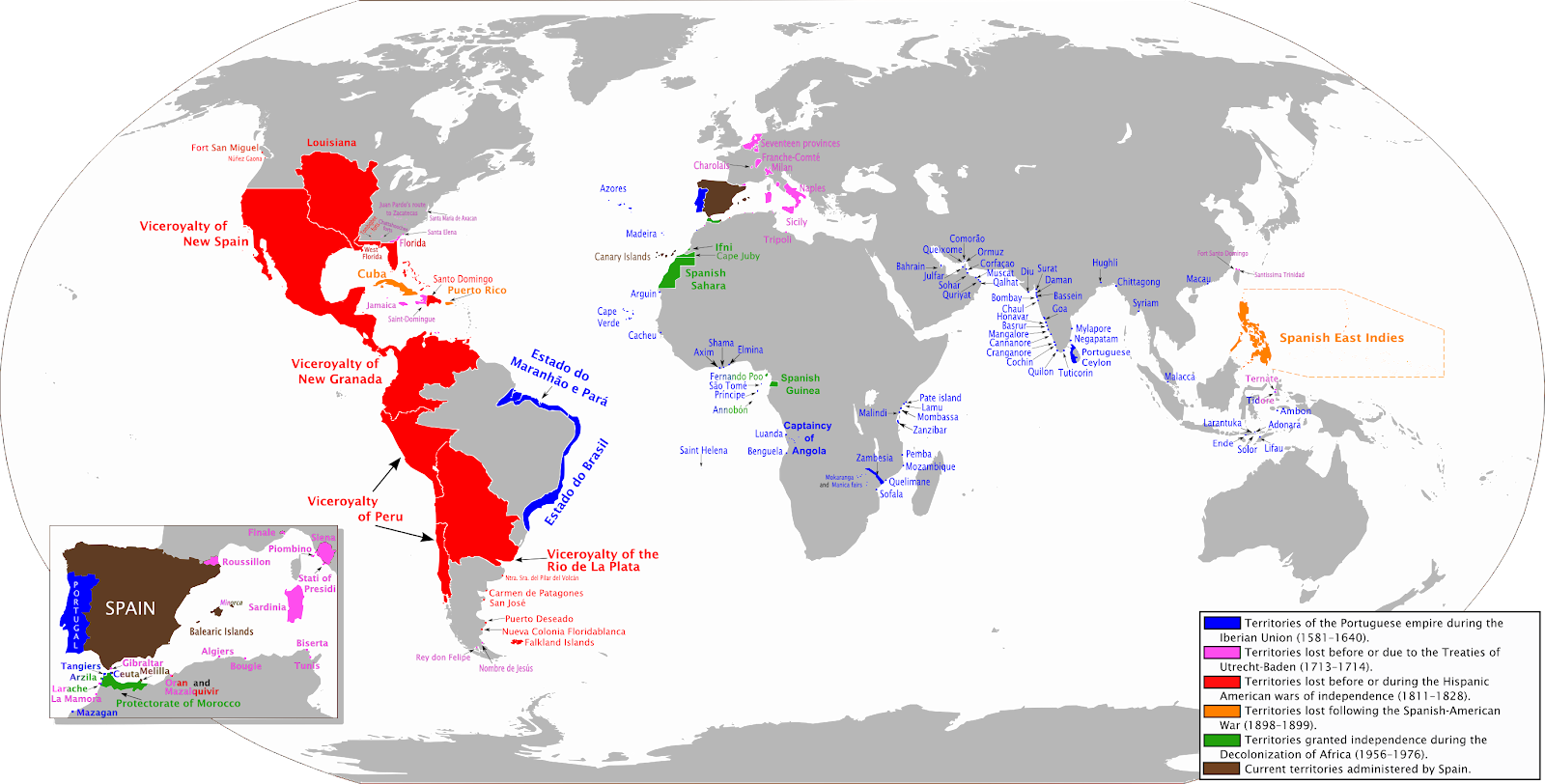
Of course, Spain concerns have little to do with the enforcement of the law, as it's obvious if you know the history of this country that never peacefully recognized the right of self-determination of its colonies; how it has been trying [1][2][3] to eradicate the Catalan language and culture for centuries and by all possible means; or more specifically and recently how Spain tried to convince the UN Security Council not to recognize the right of self-determination of the Western Sahara -a former Spanish colony now part of Morocco- and proposed abandoning "decolonization" vocabulary such as sovereignty and independence in favor of "globalization" terms such as regionalization, autonomy, and self-rule. The leaked American cable that made this information public also noted that the non-paper distributed by Spain was "also clearly colored by and suggests a solution similar to the approach which Spain has taken with its own region of Catalonia".

The Spanish Empire

Thus, it is clear that Spain is violating the right of self-determination and that the international community is not in any way trying to enforce the international law, which is not unexpected because at the moment states retain the absolute power in their territories, which is the same reason why many countries still violate human rights such as freedom of expression without having to face any drastic consequences.

Images obtained from Google where not stated differently.
For information and data sources follow the relevant links.

Read more »