2026/09/29

Turn in Catalonia: Catalan independence parties would regain the absolute majority again

Turn in Catalonia: Catalan independence would regain the absolute majority with 69 of the 135 seats in Parliament. However, the leadership of the bloc would pass to Aliança Catalana, which would increase from 2 to 26 seats according to the three latest published polls.

Read more »

2026/09/15

US Lawmaker Denounces The Harassing of Pro Independence Party Catalan Alliance


An U.S. lawmaker accuses the Spanish leader of harassing a Catalan political group, comparing the situation to that of Trump. The official highlights the party's growing support.

Republican Congressman Carlos Giménez denounced on Monday the "persecution" that, the Catalan independence party Aliança Catalana is suffering at the hands of Spanish Prime Minister Pedro Sánchez.

"From the U.S. Congress, we denounce the political persecution that the patriots of Aliança Catalana are facing at the hands of Pedro Sánchez's regime at Moncloa and his socialist-communist allies in Barcelona," he declared on the social media platform X.

Giménez wrote this message in response to a tweet by Aliança Catalana leader Sílvia Orriols, who asserted that "no political party had suffered such brutal scrutiny or public exposure" as that which—in her opinion—the candidates of her party are facing.

The Republican congressman, who is of Cuban origin, stated that what is happening is "just like what they intended" to do to U.S. President Donald Trump during the last election campaign.

"That is why it comes as no surprise that Aliança Catalana continues to grow in popularity in every poll!" he added. Giménez has been critical of Pedro Sánchez's government, which maintains a tense relationship with the Donald Trump administration due to disagreements over defense spending and Spain's opposition regarding Iran.

Read more »

2026/08/10

Junts Joins Global Sovereignty Movements at Corsica’s International Ghjurnate di Corti

Laura Borràs has reinforced Catalonia’s ties with the Corsican independence movement by leading the Catalan delegation at the 44th Ghjurnate Internaziunale di Corti in Corsica. The prominent event, organized by the pro-independence movement Nazione, brings together various global self-determination movements to foster international solidarity and discuss joint strategies. The former President of the Parliament of Catalonia, ⁠Laura Borràs, Junts per Catalunya (Together for Catalonia) traveled to Corsica to head the Catalan delegation at the 44th Ghjurnate Internaziunale di Corti. The annual summit, which concluded in early August 2026, serves as the premier international forum for stateless nations, self-determination movements, and pro-independence groups looking to build a framework for "common resistance" against centralized state policies. Organized by the newly consolidated Corsican independence party Nazione, this year’s summit arrived at a crucial geopolitical juncture. Attendees extensively criticized the ongoing "Beauvau process" negotiation with Paris, arguing that the French state's proposed institutional reforms fail to offer true autonomy.

Borràs, representing Together for Catalonia (Junts), shared a stage with delegations from other territories seeking sovereignty or greater autonomy, including: Kanaky (New Caledonia), Kabylia, Sardinia, Sicily, French Guiana, Martinique, and Guadeloupe. By participating, Borràs aimed to position the Catalan independence movement within a broader, global network of decolonization and sovereignty struggles. The political relationship between Catalan and Corsican independentists spans decades. Borràs’s presence at Corti builds on a long history of attendance by high-profile Catalan leaders. During the summit, discussions focused heavily on shared structural challenges, such as the defense of minority languages (Catalan and Corsican), regional fiscal tools, and protecting local land and real estate from foreign speculation.

Domestic Political ContextHer prominent international appearance comes immediately on the heels of major updates regarding her personal judicial situation back home. In late July 2026, the Spanish government granted a partial pardon to Borràs, reducing her previous prison sentence from four and a half years down to two years, effectively shielding her from entering prison. Despite the partial pardon, she remains barred from holding public office due to a remaining 13-year disqualification penalty. Her participation at the Ghjurnate di Corti signals that despite domestic judicial restrictions keeping her from official electoral office, she remains highly active in international diplomacy and the broader pro-independence movement.


Read more »

2026/08/03

Pro independence party joins the European Democratic Party to strengthen its "international projection"

The European Democratic Party is pleased to welcome Junts per Catalunya into our political family. "Our vision of Europe is founded on the conviction that European integration, federalism, and respect for territorial diversity go hand in hand. A stronger Europe is one that values its nations, protects its linguistic and cultural heritage, and recognises the richness of its different identities within the framework of our common European project.

This accession reinforces our commitment to the rule of law, democratic dialogue and the faithful implementation of judicial decisions across the European Union. The judgment delivered by the Court of Justice of the European Union on 16 July on the amnesty should be implemented in accordance with the principles of the rule of law and the obligations arising from the Union’s legal order.

We believe that dialogue, democracy and respect for the rule of law are mutually reinforcing principles. They are essential to strengthening trust between citizens and institutions and to building a more united, democratic and federal Europe.

Who forms the EDP?

The European Democratic Party (EDP) is a centrist, pro-European, and federalist political party composed of national political parties, regional movements, and individual politicians from across Europe. Along with the Alliance of Liberals and Democrats for Europe (ALDE), it forms the core of the ⁠Renew Europe group in the European Parliament.The party is chaired by former French Prime Minister François Bayrou (who co-founded it alongside Italy's Francesco Rutelli in 2004), with Sandro Gozi serving as Secretary General.

The EDP brings together a diverse group of centrist and regionalist parties across the EU:France: Mouvement Démocrate (MoDem) — one of the major pillars of the party, Eusko Alderdi Jeltzalea / Basque Nationalist Party (EAJ-PNV).Coalición Canaria (CC) Freie Wähler (Free Voters) from Germany and Italia Viva and Azione, Belgium's Les Engagés and Els Compromesos, Independent Ireland as well as a coalition of centrist parties including the People's Party – Reformists, HSLS, and HNS.

In addition to formal political parties, the EDP includes individual members who are Members of the European Parliament (MEPs), mayors, and regional representatives aligned with its central values of freedom, social inclusion, and European integration.

Read more »

2026/07/16

European Centrist parties celebrate the EU Court ruling: "Catalan voices must be fully heard"


The ruling by the Court of Justice of the European Union (CJEU) upholding the amnesty law has generated a swift reaction across Europe. Among the voices of support is that of the European Democrats, a centrist political group within the Renew Europe coalition in the European Parliament, which has welcomed the decision as a step towards resolving a long-standing political conflict. 

In a statement, the European Democrats, who hold 11 seats in the European Parliament, praised the Luxembourg court's confirmation that the law is compatible with EU law, thus reinforcing the legitimacy of a law that seeks "political and social normalization in Catalonia." The European ruling considers that the amnesty does not violate EU law or affect EU financial interests, and places it within the competence of member states. The European Democratic Party (EDP), a transnational political organization, consists of 20 national member parties and currently holds 11 seats in the European Parliament as part of the Renew Europe group. 

"The Court of Justice of the European Union has confirmed that Spain’s Catalan amnesty law is compatible with EU law. 

This ruling helps close a conflict marked by tensions and the exile of democratically elected Catalan representatives. We welcome it and we look ahead. 

Catalonia’s political future must be decided through democracy, dialogue and respect for its people, and in full respect of the rule of law. 

Catalan voices must be fully heard, including in the European Parliament."

Read more »

Major Catalan Win: Top EU Court backs Amnesty for the Catalan pro Independence polticians


The ECJ backs Spain’s amnesty law, saying it breaches neither EU nor anti-terror rules, although Puigdemont's arrest warrant stands until the Constitutional Court decides on his appeal. The Court of Justice of the EU (CJEU) has given broad backing to Spain's amnesty law as regards EU law, a decision that has a direct impact on the case of Carles Puigdemont, who is still waiting on a ruling by the Supreme Court. The Luxembourg judges consider the legislation neither to conflict with the European Union’s financial interests nor to run counter to the EU directive on terrorism. 

In response to two separate requests sent by Spain's Court of Audit and the National High Court for a preliminary ruling, the latter tied to the case in which Puigdemont is under investigation for terrorism, the Luxembourg judges have confirmed the view (source in Spanish) already set out by the institution's Advocate General last November. Even though the law was passed under very particular circumstances, as a condition imposed by the ERC and Junts parties for backing Pedro Sánchez's investiture, and without consulting European courts, Advocate Dean Spielmann already gave the text the green light at the time, arguing it had been approved "in a genuine context of political and social reconciliation" and ruling out that it amounted to a "self-amnesty".

Read more »

2023/10/15

Don't forget, don't forgive: Catalan Nationalist Youth pays tribute to the Catalonia's President executed by Spain 83 years ago


At dawn, as 83 years ago, the Catalan Nationalist Youth was in the Castle of Montjuïc whre the Spaniards shot the Catalonia's President lluís Companys. Serveral leaders of the main patriotic party Junts (Together) as former Catalan Speaker Laura Borràs and former politicals prisoners and MPs Jordi Turulll and Josep Rull attended the event. 

Arrested by the Gestapo, executed by Franco, still a convict in Spain today.
At dawn on October 15, 1940, Lluís Companys, then President of Catalonia, was put before a firing squad in the moat of Montjuic Castle in Barcelona and shot. The detail of soldiers executed the sentence of a court martial, pursuant to regulations recently imposed by General Franco's fascist regime. The German Gestapo had handed over to their fellow Spanish Secret Police only a few months earlier a 58 year old man who represented a country they wanted to ridicule in defeat and to teach a lesson for the future.

Exiled in France after the victory of General Franco in the Spanish Civil War, he was arrested by the Nazi secret police in La Baule-Escoublac (Brittany) on 13th August 1940, an arrest witnessed by a policeman who had come expressly from Spain. Mr Companys was first interrogated by that officer at La Santé prison in Paris, he was placed under his custody and taken to Madrid, where he was tortured.
On 3rd October, the President was transferred to Barcelona to be summarily court-martialled. He was sentenced to death —with a shot of macabre fascist irony— for "participation in a military rebellion", in a one-day trial and without even meeting the few legal guarantees to be observed under the dictatorship.

He was shot immediately afterwards, on the morning of 15th October 1940, at Montjuic Castle where he had been taken and tried—on the mountain where the Olympic stadium that now bears his name stands. President Companys was the only democratically-elected government leader in Europe to have been executed in the twentieth century, and is still today the symbol of Gen. Franco's persecution of Catalan Republicans.
 

Special Edition: Lluís Companys, October 1940 123rd Catalan President executed by Spanish government 


Download and share


Waiting for Spain’s apology

In the summer of 1940, during the dictatorship of Franco, the exiled Catalan President Lluís Companys was detained in France, and was then taken by French and Gestapo officers to Francoist authories in Spain, who executed him. This 15th of October will be the 74th anniversary of his execution.

On 15 October 2008, the Commission on Dignity and the Vice-President’s Office of the Generalitat of Catalonia put together an Act of Amends to ex-President Lluís Companys, along with the Consul of Germany, Christine Gläser, and the Consul of France, Pascal Brice read more...

Catalonia's President Lluís Companys


Arrested by the Gestapo, executed by Franco, still a convict in Spain 2014.
At dawn on October 15, 1940, Lluís Companys, then President of Catalonia, was put before a firing squad in the moat of Montjuic Castle in Barcelona and shot. The detail of soldiers executed the sentence of a court martial, pursuant to regulations recently imposed by General Franco's fascist regime. The German Gestapo had handed over to their fellow Spanish Secret Police only a few months earlier a 58 year old man who represented a country they wanted to ridicule in defeat and to teach a lesson for the future.

Exiled in France after the victory of General Franco in the Spanish Civil War, he was arrested by the Nazi secret police in La Baule-Escoublac (Brittany) on 13th August 1940, an arrest witnessed by a policeman who had come expressly from Spain. Mr Companys was first interrogated by that officer at La Santé prison in Paris, he was placed under his custody and taken to Madrid, where he was tortured read more...

Lluís Companys' Legacy

Companys is sitting while he waits in the living room. They tell him that someone just knocked on the door. “Lluís, les allemandes sont arrivées!” (Lluís, the Germans are here). Calmly, he turns the page of the book he is holding and keeps reading. The members of the German police find him in his chair, reading Vies des saints (Lifes of Saints). Being as he is a liberal politician, of strong unionist convictions, his reaction is profoundly telling. He could have fled many days ago, but he's tired. Besides, he has important reasons for staying in France. His son, Lluïset, ill with schizophrenia, disappeared from the French mental hospital he was in after a bombing by the Germans forced it to be shut down. What will men be capable.... read more

74 years of national and democratic humiliation

On August 13, 1940 began what would become a dark chapter in the history of Catalunya. The Franco regime was about to perpetrate a unique crime: the murder of a democratically elected President. Six men stormed the residence of Lluís Companys, President of the Catalan government, at La Baule in Brittany. He was captured by four men in German Nazi police uniforms and two civilians. One of them was Pedro Urraca Redueles, officially a police attached in the Spanish embassy in Paris, in reality a spy paid by the Franco regime to serve as liaison with the Gestapo and the Vichy Regime and to coordinate in part the repression of Spanish republican exiles in France. On that day Lluís Companys started a journey that would end tragically two months later, on October 15, 1940, with his execution in Montjuïc, Barcelona, after an illegal ... read more

Franco's persecution of the Republican refugees in France

Just after Hitler’s armies had defeated France, Franco's Government took advantage of the victory of its Nazi allies and began to act against the Republican exiles in French territory. On the one hand, it tried to destroy all the organizations that the refugees were maintaining in exile and to expropriate their properties and documentation; on the other hand, with the collaboration of Germany, it tried to get various Republican personalities who were in the "German-Occupied Zone" arrested and transferred to Spain, while getting others who were in the Vichy "Free Zone" arrested and extradited ... (read more)


Help Catalonia is an association that receives no subsidies whatsoever from the Spanish state, the Catalan government or indeed any other organisation. We, the people who work in this project, do so on a voluntary basis and for no financial gain whatsoever.
 

Read more »

2022/10/02

60,000 mark the fifth anniversary of the 1-O, the self-determination referendum held on 2017 and deepens the ERc's sinking


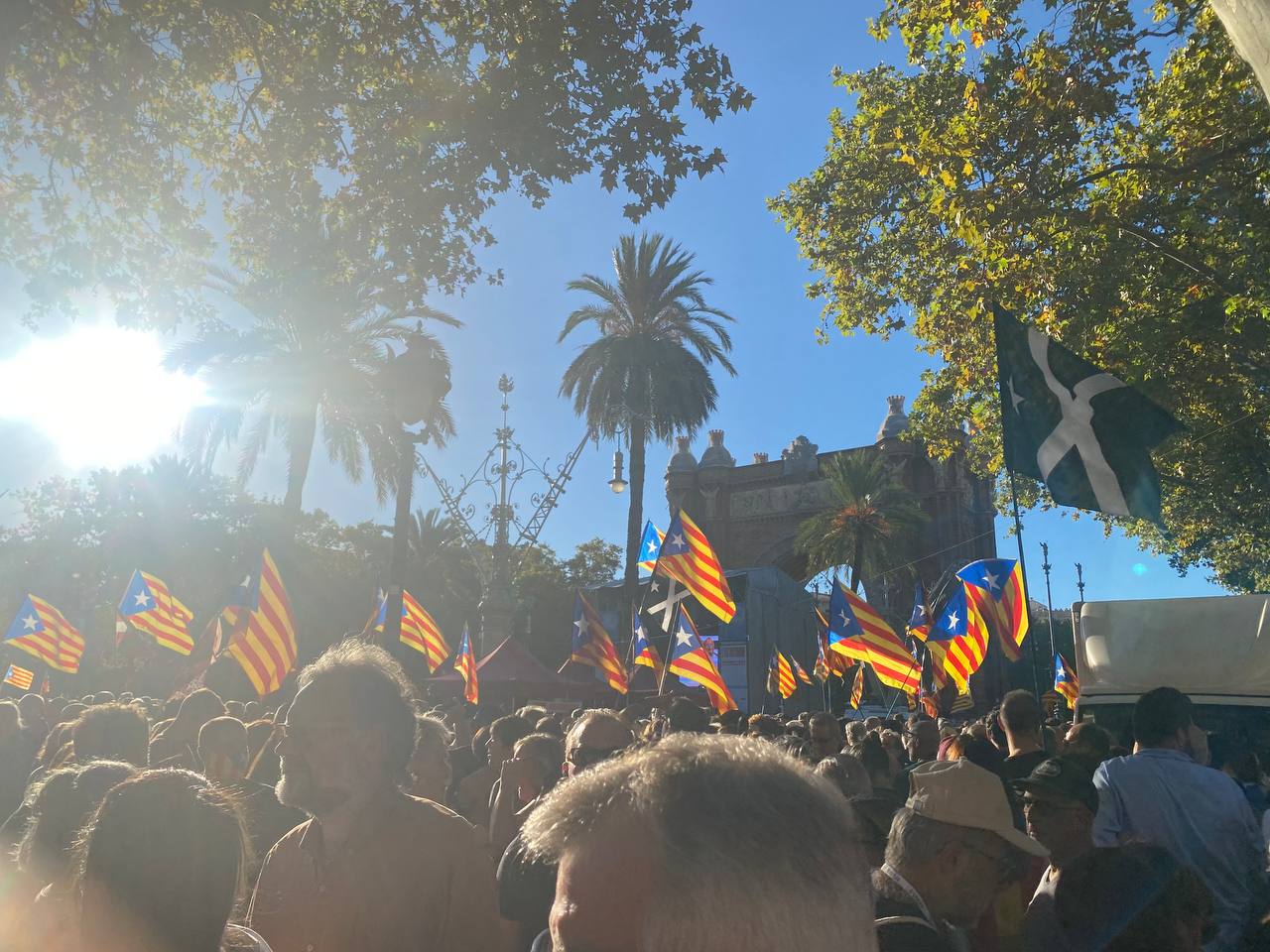
The event organized in Barcelona this Saturday to mark the fifth anniversary of the 1-O, the self-determination referendum held on October 1st, 2017 was attended by 60,000 people. What was most evident was the vast divide separating the thousands of people who gathered in front of the Arc de Triomf in defence of the validity of the referendum, and Catalonia's Republican Left (ERC) political leadership that has abandoned the 1-O.​​

In fact the dismissal of vice president Jordi Puigneró (Junts) by president Pere Aragonès (ERC) only three weeks after the Diada demonstration from which the ERC leadership absented itself, is already clear. The first signs were given at the very start of the event, when it was recalled that the Spanish state's repression had, among other consequences, led to the situation of there being five people in exile who were unable to come personally to Barcelona. The names of Lluís Puig, Clara Ponsatí and Toni Comín, from the Junts space, received loud applause, and this multiplied when the name of Carles Puigdemont was read, prompting a shower of praise and chants of "president". Only one of the figures in exile was criticized: the name of the ERC general secretary, Marta Rovira, provoked jeers among the public.

The ERC space also could not avoid the crowd's derision, a few moments later, when senior ERC figure Carme Forcadell went on stage. During her speech, calls of "traitor" and "out" were heard among the public:  "Many of you are angry, disappointed and disillusioned. I understand that and I share it.", she said. But it 's too late. Her party is sinking day by day. 


Carles Puigdemont and the ANC get all the warmth

Carles Puigdemont, the president-in-exile, who spoke live via telematic means, was enthusiastically welcomed by an audience that, for long periods, remained silent listening to his words. A tranquility that was broken after several messages from Puigdemont, such as his "immense thanks" to the citizens who made the 1-O possible, his warning that those "delusional undertakers" should give up any hope that the people will forget about independence, and his defence that "there is no need to repeat" any referendum because the 2017 one is still valid, as opposed to the "clarity" proposal of the Catalan president, Pere Aragonès. Even his appeal for the unity of the independence movement was well received: "The only table to which we must chain ourselves is the dialogue table between the siblings of Junts, ERC, the CUP, Òmnium and the Assembly". Unlike the other speakers who spoke along these lines, Puigdemont was applauded. 
The Catalan National Assembly (ANC), as well, was welcomed with open arms. In her speech, Dolors Feliu saw how her strategy, marked by the desire to put an end to the dialogue table with the state and start a new democratic attack in the short term, was strongly applauded. Her criticism of the "immobility" of the parties was warmly received by the public, as well as her call to "open new paths". Thus, the ANC president returned to the threat of a early election and a civil list, bypassing the parties, if the Catalan government does not comply with its pro-independence mandate.

Appart from the Barcelona's event there were meetings all over Catalonia and a rally in Girona where hundreds burned the ERC's effigy portrait and a Spanish banner.


Read more »

2022/09/29

Enough is enough: 15 City Councils in Northern Catalonia will fight to recognize the right of councilors to use Catalan

On Friday, it was announced that the Elna City Council would go to trial following the decision of the councilor plenum to modify the municipal regulations to recognize the right of councilors to use Catalan, as long as the interventions are fully translated into French. The Intermunicipal Union for the Promotion of Occitan and Catalan Languages ​​(SIOCCAT), that there are at least fifteen northern Catalan municipalities that will also introduce Catalan into the municipal regulations. If nothing else, there are Banys and Palaldà (Vallespir), Espirà de Conflent, Estagell (Rosselló), Formiguera (Capcir), la Menera (Vallespir), Tor de França (Fenolleda), Pesillà de la Ribera (Rosselló), Portvendres (Rossello), Ralleu (Conflent), Sant Andreu de Sureda (Rossello), Sureda (Rossello), Tarerac (Conflent), Trillà (Fenolleda) and Vingrau (Rossello). 

Some of these councils have already received a threatening letter from the prefect demanding that they back down, and, according to SIOCCAT sources, some councils have already given up. Rodrigue Furcy, prefect of the Department of the Eastern Pyrenees, justifies the ban on Catalan by adding that article 2 of the French constitution says that the language of the republic is French. He also argues that French courts have ruled several times that plenaries in a language other than French are illegal.


Nicolas Garcia, Elna's Mayor for the PCF

Read more »

2022/09/14

The EU Comission denounces Spain: No rule of law as it is failing to comply the 61 % of the ECHR rulings

The Kingdom of Spain is failing to comply with the rulings of the ECHR, with 61% still pending, EU Comissioner for Justice, Didier Reynders reminds, and the average time of pending implementation is over three years. Spain is a deficient democracy where human rights don’t really matter.

The European Commissioner for Justice, Didier Reynders, in response to a question from Spanish MEPs, recalled that on January 1, 2022, Spain had 23 main judgments of the ECHR pending compliance. "On that date, the percentage of main judgments handed down during the last ten years and pending compliance in Spain was 61%, and the average period during which the judgments had been pending compliance was three years and one month", add.

Reynders recalls in his written response that compliance with the judgments of the Strasbourg Court, in particular with regard to the main judgments, is an important indicator of the functioning of the Rule of Law in a country, and that the report on the Rule of Law drawn up by the Commission has included this year for the first time an overview of the application of ECtHR judgments in each State.

Read more »

2022/08/31

The United Nations’ (UN) Human Rights Committee: Spain violated political rights of Catalan national minority leaders

 The United Nations’ Human Rights Committee has stated that Spain “violated” the political rights of four formerly jailed Catalan leaders, convicted for their roles in organizing the 2017 referendum on independence.

The opinion was released on Wednesday and refers to the fact that former vice president Oriol Junqueras, together with former ministers Raül Romeva, Josep Rull and Jordi Turull were stripped as MPs before having been convicted in October 2019.

During their pretrial detention, the four former Parliament members brought their case to the Committee, alleging that their suspension from public duties, prior to any conviction, violated their political rights under Article 25 of the International Covenant on Civil and Political Rights. In October 2019, the four of them were convicted of sedition, a crime that does not include the element of violence, as opposed to rebellion, and their suspensions were lifted.

Taking note that the four complainants had urged the public to remain strictly peaceful, the Committee considered that the decision to charge them with the crime of rebellion, which led to their automatic suspension prior to a conviction, was not foreseeable and therefore not based on reasonable and objective grounds provided for by law.

“The Committee took an important step in affirming that the safeguards against the restrictions of political rights must be applied more rigorously if these restrictions occur prior to, rather than after, a conviction for an offence,” said Committee member Hélène Tigroudja. “The decision to suspend elected officials should rely on clear and foreseeable laws which establish reasonable and objective grounds for the restriction of the political rights, and must be applied based on an individualized assessment. Such an approach and safeguards are the best way to ensure respect for institutions and to promote the rule of law in a democratic society,” she added.


Read more »

2022/04/03

'Collabo Government' rally held in front of the HQ of the autonomous government


The Catalans for Independence formation, created by former members of the ANC leadership, dissatisfied with the mandate of Elisenda Paluzie, gathered a hundred people yesterday in front of the Palau de la Generalitat, in a rally led by the slogan “we will not vote us again ”. During the event, a manifesto was read in which the group declares that they feel cheated by the "15-M scammers", referring to the City Council, and by the "October 1 scammers , referring to the Generalitat (Catalan autonomous government). "We are not in rebellion, but we no longer recognize you, and that is why we will not vote for you again," they said, addressing the current pro-independence deputies. The formation, created in 2021, aims to "bring together pro-independence activists who are not willing to give up the October 1 mandate or wait for future generations to implement it."


Read more »

2022/04/01

A dozen of ERC party headquarters defaced as Spanish collaborationists and "to betray independence"


The Committee for the Defense of the Republic - Direct Action has claimed that it has painted on the facade of several ERC headquarters, as well as some of Junts and the CUP in various localities, with the inscription "Consulate of Spain" to denounce the which considers the inaction of the parties in resuming the independence process. The CDR-Acció Directa has published on the web how the graffiti was done in various towns, such as Mollerussa, Alcarràs, Terrassa, Balaguer, Barcelona, ​​Rubí, Sant Cugat del Vallès and Vic. "If you continue to manage autonomy, you will face us. If you continue to betray independence, we will continue to point to yours. Today we made official what we all knew: new consulates in the territory ", they pointed out on the network. In a manifesto published a year ago, the CDR-Acció Directa criticized the action of the pro-independence parties, assuring that they were trying to "seek demobilization", and announced that it would take action in protest.

Meanwhile, pro-independence parties in addition to the PSC and the commons are now waiting to see if they will change the language policy law. If last Thursday the PSC, ERC, Junts i comuns convincingly presented an agreement to incorporate Spanish as a language for school use, today this agreement has the brakes on. The widespread rejection of civil society on Thursday evening led to Junts withdrawing from this agreement, while the other three groups called on those of Carles Puigdemont not to deviate from the consensus reached by more than 100 deputies. The amendment to the Language Policy Act was due to begin debating in the plenary next week, the groups said, but it has no date at the moment, although it is likely to be addressed in the plenary session of the April 28th.
for Taboola

This was explained by parliamentary sources after the Bureau and the Board of Spokespersons met this week. They say they have set the agenda for next week's plenary, which will only last two days because there are "few motions", and that this bill will not be addressed to change the rules. These sources have detailed that there is no date at the moment and that the decision not to put it in the next plenary session has been an agreement of the groups. In addition, the CUP has asked to unilaterally set its proposal to amend the LEC for next week’s plenary session, which calls for only Catalan to be recognized in schools, but the groups have rejected it.

On the other hand, ninety personalities have signed a manifesto against the controversial language agreement at school, arguing that “it cannot be approved because it constitutes a threatening setback for the future of the language in an area that is key to normalizing -the". A més, “la incorporació explícita de la vehicularitat del castellà en una llei catalana representaria un pas enrere que el català no es pot permetre en la situació de feblesa actual, accentuada entre la població més jove”, afegeix. Clara Ponsatí, Elisenda Paluzie, Quim Torra and Lluís Llach are some of the personalities who have supported the text released this week. The manifesto ‘Defensem l'escola en català’ explains that “this waiver, apart from being dangerous, would be sterile and gratuitous, and would not serve to respond to the judicial requirements of the TSJC ruling”. "We already know, as we have seen in the Valencian Country, that the courts, based on lawsuits from public and private bodies that have not stopped, would continue to attack the school in Catalan under any pretext," he recalls. Therefore, he insists that "the government cannot give in to the legal challenge that, without any pedagogical criteria, seeks to overthrow a model that promotes social cohesion and has the support of the vast majority of society." "In fact, it gave way when in 2020, in the negotiation of the Celaá Law with the government of Pedro Sánchez, it did not demand that the Spanish government withdraw the appeal that has ended up giving rise to this sentence," he said.

The CDR-AD was born on St. George's Day 2021. In a statement, the new group, called CDR Direct Action, explained that it includes the legacy of all those who have fought for independence, especially the courage of all those retaliated against. , to take a walk on the political stage from the street. "In this context, between the demobilization sought, the Offec of Spain and the so-empty and embarrassing words of Catalan parties we are born the Defense Committee of the Republic - Direct Action," says the statement.
 

Read more »

2021/02/15

Pro independence parties rise from 47,5 % to 51,14 % and from 70 to 74 MPs

The pro-independence parties have won more than 50% of the vote in elections in Catalonia for the first time. The sum of ERC, JxCat, CUP, PDeCAT, Primary and FNC has been imposed on a total of 837 of the 947 Catalan municipalities. This is a higher figure than in 2017, when the pro-independence formations that presented themselves achieved this in 815 municipalities.

The turnout goes down from 79,09 % to 53,54 % amisdt the pandemics. Pro independence parties go down a 30 % but the pro Spanish go down a 40 % in spite of the rise of Vox, a new Fascist party which bursts in with a 7,7 %. The Catalan Independence front goes from 47.5% to 51.14% thanks to the decrease in participation that most strongly affects Spanish nationalism. Despite the advances it loses 630,000 votes. mainly due to the decline in ERC (-35%). JxCat and PDeCAT also collect 32% less votes than in 2017 and the CUP is down 3%. The Spanish forces lose 40% of the vote (the independence setback is 30%). C'anos falls 85%, PP 41% and Comuns 40%. All this makes it easier for Spanish nationalism to go from 65 to 61 seats, while the independence frontgoes from 70 to 74 MPs.

Although the three pro-independence forces of 2017 went from 2,079,000 votes to 1,360,696 and, as a percentage, only grew from 47.5% to 48.01, the presentation of other lists allows it to grow to 51.14% :

ERC 21.30% 33 MPs

JxCat 20.04% 32 MPs

CUP 6.67% 9 MPs

PDeCAT 2.72%

Primary 0.21%

FNC 0.18%

SCat 0.01%

MCR 0.01%

Overall, 1,448,901 people voted for pro-independence forces and 1,347,103 for Spaniards in the absence of a foreign vote.


Read more »

2021/01/19

Seven Catalan pro independence lists achieve to run the next elections

Apart from the parties that did not need to collect guarantees, such as the centrist PDeCat, far left CUP and leftist ERC, several formations have tried to get them. Força Catalunya and the Bloc Sobiranista Català, which had closed a coalition, did not succeed. Neither ARA (Assembly of Retaliators and Activists) and Corrent Roig, although they will be able to appear in the constituency of Tarragona under the name of the Trotskyist party. Also Trotskyist Lluita Internacionalista (which calls for a critical vote for the CUP) and CRT have criticized the position of Corrent Roig to promote its own list. Neither Anticapitalists nor the Revolutionary Left have clarified their position.

Together for Catalonia (JxCAT) obtained 52,000 endorsements, the Front Nacional de Catalunya (with the support of Renaixença and Via Única) 7,500 and Primàries Catalunya 7,060. All three formations will be presented in all four constituencies. the tweeter Laura Ormella heads the list of Primary, The president of the Catalan Business Circle, Albert Pont, of Via Única will lead the list of the FNC, and Laura Borràs, former Minister of Culture, Junts. The last one has the support of 8 parties: Regrouping, Independentistas d'Esquerres, Moviment d'Esquerres, Demòcrates de Catalunya, Estat Català, Solidaritat Catalana per la Independència, Acció per la República and Alternativa Verda-Els Verds. The CUP has closed an agreement with Guanyem criticized by Endavant (OSAN) and Lluita Internacionalista.

Therefore in the elections of the Principality there will be

1. ARA-Corrent Roig (only in Tarragona)

2. CUP

3. ERC

4. FNC

5. Together

6. PDeCAT

7. Primary

Apart from these, there are also various formations defending the right to self-determination such as the Catalan Nationalist Party (split from the PDeCAT), the Communist Party of the People of Catalonia, the Communist Party of Workers of Catalonia (a split split from the previous one). ).


Read more »